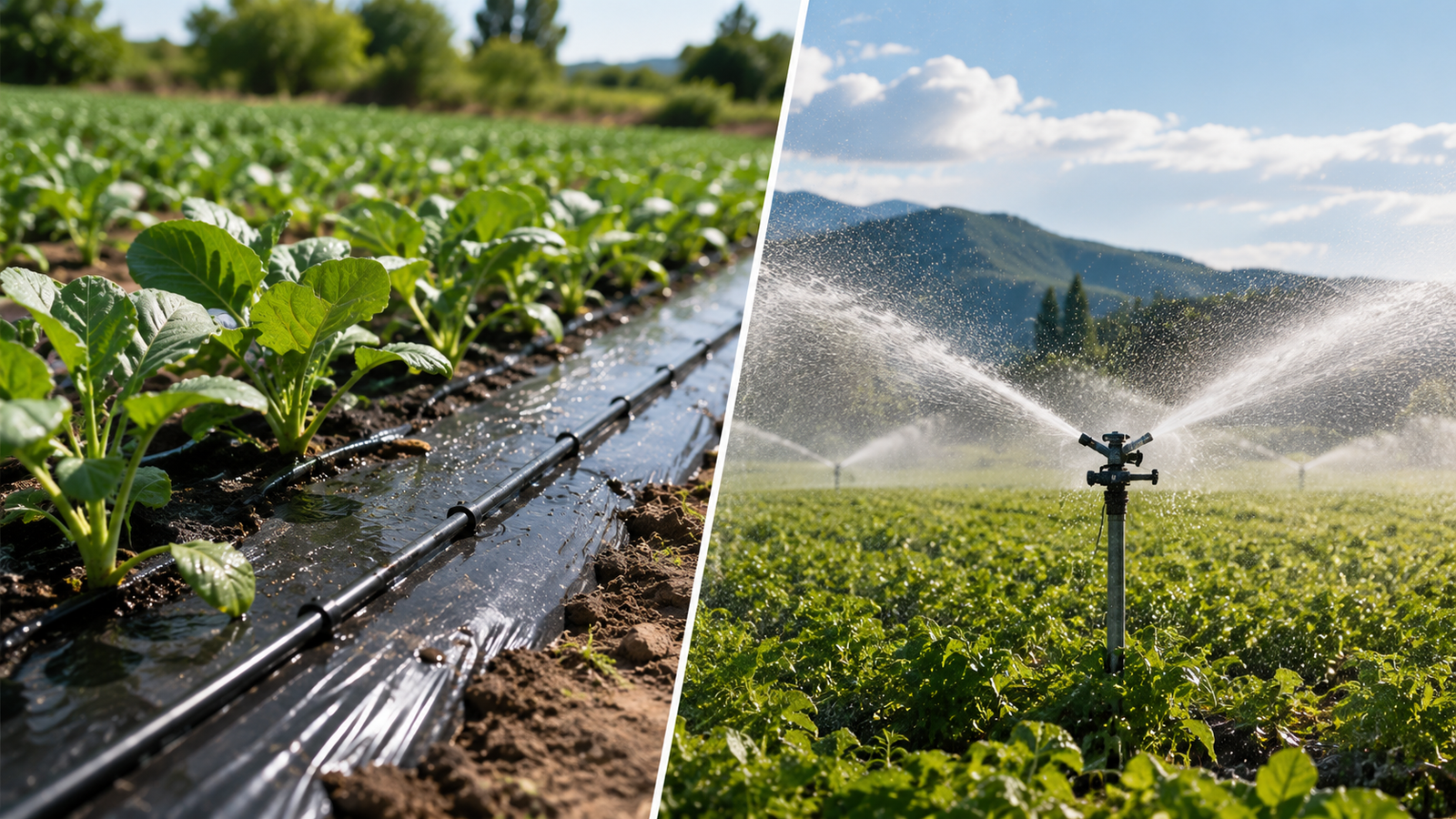
Drip Tape vs Sprinkler Irrigation: ROI & Cost Comparison 2026
The drip tape vs sprinkler irrigation decision affects water use, crop disease pressure, fertilizer efficiency, and system lifespan — all of which feed directly into farm ROI. This guide compares both systems across 6 dimensions and gives clear recommendations by crop type and farm context.
Focus keyword: drip tape vs sprinkler irrigation · Updated: June 2026 · Reading time: ~7 min
▶ Quick Answer
In the drip tape vs sprinkler irrigation comparison, the answer depends on crop type:
- High-value vegetables (peppers, tomatoes, strawberries): Drip tape wins — 30–50% water saving, dry foliage reduces disease, fertigation precision, better export-grade yield.
- Large-scale field crops (wheat, broad-acre corn): Centre-pivot sprinkler can be more cost-effective per hectare at scale.
- Water-scarce environments (any crop): Drip tape — 90–95% application efficiency vs 70–80% for sprinkler.
- Frost protection required: Overhead sprinkler — cannot be replaced by drip tape for this purpose.
What Different Buyers Actually Care About
🌍 Export Vegetable Farm Operators
For farms growing peppers, tomatoes, or strawberries for supermarket export, the drip tape vs sprinkler irrigation decision has a direct quality dimension: overhead sprinkler wets foliage and promotes fungal disease, while drip tape keeps canopy dry. In humid growing regions — including much of Southeast Asia and tropical Latin America — this difference can significantly reduce fungicide programme costs and crop loss.
They need: Water use data, disease impact evidence, and yield quality comparison by system.
📋 EPC & Project Consultants
Irrigation infrastructure projects involve system selection decisions that affect the project’s 10–20 year cost and performance profile. EPC consultants specifying irrigation systems for government agricultural development programmes need a defensible ROI framework for the drip tape vs sprinkler irrigation recommendation — one that accounts for water cost, crop type, terrain, and maintenance capacity.
They need: Quantified comparison across water efficiency, installation cost, maintenance, and yield impact.
💧 Water-Scarce Region Operators
In regions where water costs are high or supply is limited — the Jordan Valley, Saudi Arabia, northern Mexico, parts of Peru — the efficiency advantage of drip tape in the drip tape vs sprinkler irrigation comparison becomes the primary economic argument. A 35% reduction in water use is not an environmental benefit in isolation; it is a direct reduction in operating cost and a hedge against water availability risk.
They need: Water saving quantification and payback period calculation for their water cost context.
🌱 Farm Modernisation Decision-Makers
Farms transitioning from traditional surface irrigation or overhead sprinkler systems to drip tape need to understand the full economic picture before committing to the conversion. The drip tape vs sprinkler irrigation comparison for these buyers must include upfront conversion cost, learning curve, and realistic payback timeline alongside the efficiency and yield quality benefits.
They need: Honest total-cost comparison including installation, running, and replacement costs.
6-Dimension Comparison: Drip Tape vs Sprinkler Irrigation
1
Water Use Efficiency
Drip tape achieves 90–95% application efficiency — water is delivered directly to the root zone with minimal evaporation. Sprinkler systems achieve 70–80% under good conditions, dropping to 60–65% in high-wind or high-temperature conditions. Over a 120-day growing season, this efficiency difference on a 10-hectare farm at typical water costs represents a significant operating cost differential.
90–95% efficiency ✅ Wins
70–80% efficiency
2
Crop Disease Pressure
Overhead sprinkler wets foliage — creating the humid canopy conditions that promote fungal diseases including early blight (Alternaria solani) in tomatoes, botrytis in strawberries, and phytophthora in peppers. Drip tape keeps the canopy dry, irrigating only the root zone. For high-value export vegetable crops, disease reduction from drip tape vs sprinkler irrigation translates directly to reduced fungicide spend and lower crop loss risk.
Dry canopy — lower disease risk ✅ Wins
Wet canopy — higher fungal risk
3
Fertigation Capability
Drip tape enables precise fertigation — delivering soluble nutrients directly to the root zone at the exact growth stage that requires them. When paired with a smart fertigation system, fertilizer use efficiency improves by 20–30% compared to sprinkler fertigation or broadcast application. Sprinkler fertigation is possible but delivers nutrients to the entire soil surface and leaf area rather than the root zone.
Precise root-zone fertigation ✅ Wins
Surface-wide application
4
Installation & Infrastructure Cost
For row crop vegetables, drip tape installation is typically lower cost per hectare than permanent sprinkler infrastructure. The tape itself is inexpensive, mainline requirements are simpler, and no overhead structure is needed. For broad-acre field crops where centre-pivot sprinkler covers large areas with minimal labour, the economics can favour sprinkler at scale. The correct comparison is always system lifespan total cost, not upfront capital.
Lower for row crops ✅
Lower for broad-acre ✅
5
Terrain Adaptability
Standard drip tape (non-pressure-compensating) performs best on flat to mildly sloped terrain. For significant slopes, pressure-compensating drip line is required for uniform output. Centre-pivot sprinkler is designed for flat terrain. For steep hillside orchards, drip line with PC emitters is the standard. For the drip tape vs sprinkler irrigation comparison on sloped vegetable land (under 5% grade), drip tape with good system design performs effectively.
Flat to mild slope (PC line for steep)
Flat terrain optimal
6
Maintenance & System Longevity
Drip tape for annual crops is replaced seasonally — low individual unit cost, but cumulative seasonal labour and material cost. Sprinkler infrastructure (pipes, heads, motor, pivot) is a long-term capital asset requiring maintenance but not annual replacement. For permanent crops (orchards, vineyards), drip line rather than tape is the correct comparison point — drip line shares the longevity profile of permanent sprinkler infrastructure.
Seasonal replacement (annual crops)
Long-life infrastructure ✅
Full Comparison Table
| Factor | Drip Tape | Sprinkler | Winner |
|---|---|---|---|
| Water efficiency | 90–95% | 70–80% | Drip Tape |
| Foliage disease risk | Low (dry canopy) | Higher (wet canopy) | Drip Tape |
| Fertigation precision | Root zone direct delivery | Surface distribution | Drip Tape |
| Row crop installation cost | Lower per ha | Higher per ha | Drip Tape |
| Broad-acre field crop cost | Higher (tape quantity) | Lower (pivot coverage) | Sprinkler |
| Frost protection | Not possible | Effective | Sprinkler |
| Germination support | Limited (subsurface only) | Effective surface moisture | Sprinkler |
| Export crop yield quality | Higher grade consistency | Variable | Drip Tape |
Reference: FAO Irrigation and Drainage. For product specifications, contact our team.
Recommendation by Crop and Farm Type
| Crop / Context | Recommended System | Primary Reason |
|---|---|---|
| 🌶️ Peppers (export) | Drip Tape | Dry canopy, yield uniformity, fertigation |
| 🍅 Tomatoes (export) | Drip Tape | Blight reduction, grading consistency |
| 🍓 Strawberries | Drip Tape | Crown rot prevention, size uniformity |
| 🌽 Corn (large-scale) | Centre-Pivot or Drip Tape | Depends on water cost and field size |
| 🍇 Orchards | Drip Line (PC) | Permanent system, efficiency, slope tolerance |
| 🌾 Wheat / Grain | Centre-Pivot Sprinkler | Broad-area coverage, germination support |
| ❄️ Frost-risk crops | Overhead Sprinkler | Frost protection — drip tape cannot provide this |
| 💧 Water-scarce (any crop) | Drip Tape / Drip Line | 90–95% efficiency — 30–50% less water |
ROI Calculation Framework
When evaluating drip tape vs sprinkler irrigation for a system conversion or new installation, include these four categories in your calculation:
Savings from Drip Tape
- Water cost reduction (30–50%)
- Fertilizer efficiency gain (20–30%)
- Reduced fungicide applications
- Export-grade yield improvement
Costs of Drip Tape
- Initial installation and mainline
- Seasonal tape replacement
- Filtration system investment
- Learning curve and management time
For a complete drip tape specification and quantity estimate for your farm,
use our per-hectare calculator
and view specifications on our drip irrigation tape product page.
Planning a drip tape system or evaluating a switch from sprinkler?
Tell us your crop, field size, and current irrigation setup — we will confirm the right drip tape specification and provide a quantity estimate and quotation. We respond within one business day.
Frequently Asked Questions
Drip Irrigation
Sprinkler Irrigation
Water Saving
Farm ROI
Irrigation Planning
Smart Farming