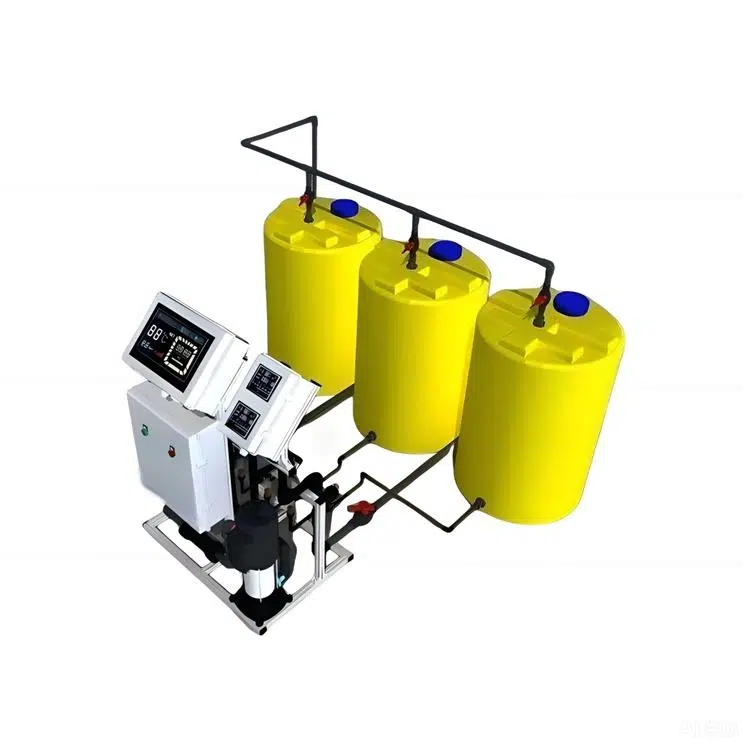
Smart Fertigation System: An In-Depth Technical Guide for Global Agriculture
Maximizing Crop Performance through Integrated Automation and Precision Nutrient Delivery.
1. What is an Industrial Smart Fertigation System?
In the competitive world of large-scale agriculture, managing crop nutrition manually is no longer viable. A Smart Fertigation System is an automated unit that acts as the “command center” for your farm, precisely injecting soluble fertilizers into the main water line. By utilizing advanced sensors to monitor Electrical Conductivity (EC) and pH levels, the system ensures that the nutrient solution is perfectly tailored to the specific growth stage of the plant.
For high-value crops like Shine Muscat Grapes, consistency is key to market success. Precision dosing via a Smart Fertigation System guarantees that every plant receives uniform brix-enhancing nutrients. According to the FAO, integrated fertigation management is one of the most effective ways to reduce environmental leaching while boosting overall biomass.
2. Hardware Composition & Dosing Principles
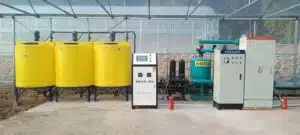
A professional-grade unit is not just a simple pump; it is a modular electronic ecosystem. The hardware of a high-performance Smart Fertigation System includes:
- Industrial PLC Logic Controller: The high-speed brain capable of executing complex irrigation programs and storing seasonal recipes.
- Multichannel Dosing Channels (3-6 Channels): Independent lines for Nitrogen, Phosphorus, Potassium, and Acid/Base correction.
- Digital Flow Meters: Sensors that provide real-time feedback on water volume, ensuring correct dosage regardless of pressure fluctuations.
- IoT Cloud Gateway: Integrated 4G or WiFi modules that allow farm managers to monitor data from their smartphones globally.
The core principle is feedback-loop control. The Smart Fertigation System continuously samples the water, compares it against the target recipe, and adjusts the dosing pumps in milliseconds to maintain a stable EC/pH profile.
3. Synergy: Connecting Machine with Drip Irrigation Tape
The most common mistake in modern irrigation projects is focusing on the machine while neglecting the delivery network. A Smart Fertigation System is the “brain,” but the drip irrigation tape acts as the “arteries.”
Pairing our system with our professional drip irrigation tape is vital for two reasons:
1. Clog Resistance: Concentrated nutrient solutions can cause sediment buildup. Our tape uses turbulent flow emitters that keep particles in suspension.
2. Uniform Distribution: If your drip tape has a high coefficient of variation (CV), the precision mixing done by the Smart Fertigation System will be wasted as plants at the end of the line receive less nutrition.
4. Commercial ROI: Why the Investment Pays Off
For B2B importers and agricultural developers, the decision to implement a Smart Fertigation System is driven by financial logic. Typical projects see a return on investment within 1.5 to 2 harvest cycles due to:
Labor Efficiency: Automation replaces the need for full-time mixing technicians. In large-scale orchards, this can reduce management costs by over 45%.
Fertilizer Savings: Precision application means you only use what the plant can absorb. Many farms report a 30% reduction in total fertilizer expenditure once a Smart Fertigation System is integrated with soil moisture sensors.
5. Installation Standards & Life-Cycle Maintenance
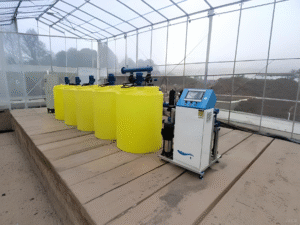
To achieve a 10-year lifespan for a Smart Fertigation System, haishun recommends strict adherence to the following protocols:
- Environmental Protection: The unit must be installed in a ventilated pump house to avoid direct UV and humidity damage to the PLC.
- Sensor Calibration: EC and pH probes should be calibrated with standard buffer solutions every 30 days.
- Filtration: A secondary disc or screen filter must be installed after the Smart Fertigation System to protect the downstream drip irrigation tape from any undissolved particles.
Technical FAQ
How many zones can one system control?
Our advanced Smart Fertigation System can manage up to 24-48 independent irrigation zones through the solenoid valve expansion module.
Is it compatible with hydroponic systems?
Absolutely. The high precision and frequency of the dosing logic make it ideal for recirculating hydroponic setups where pH stability is critical.