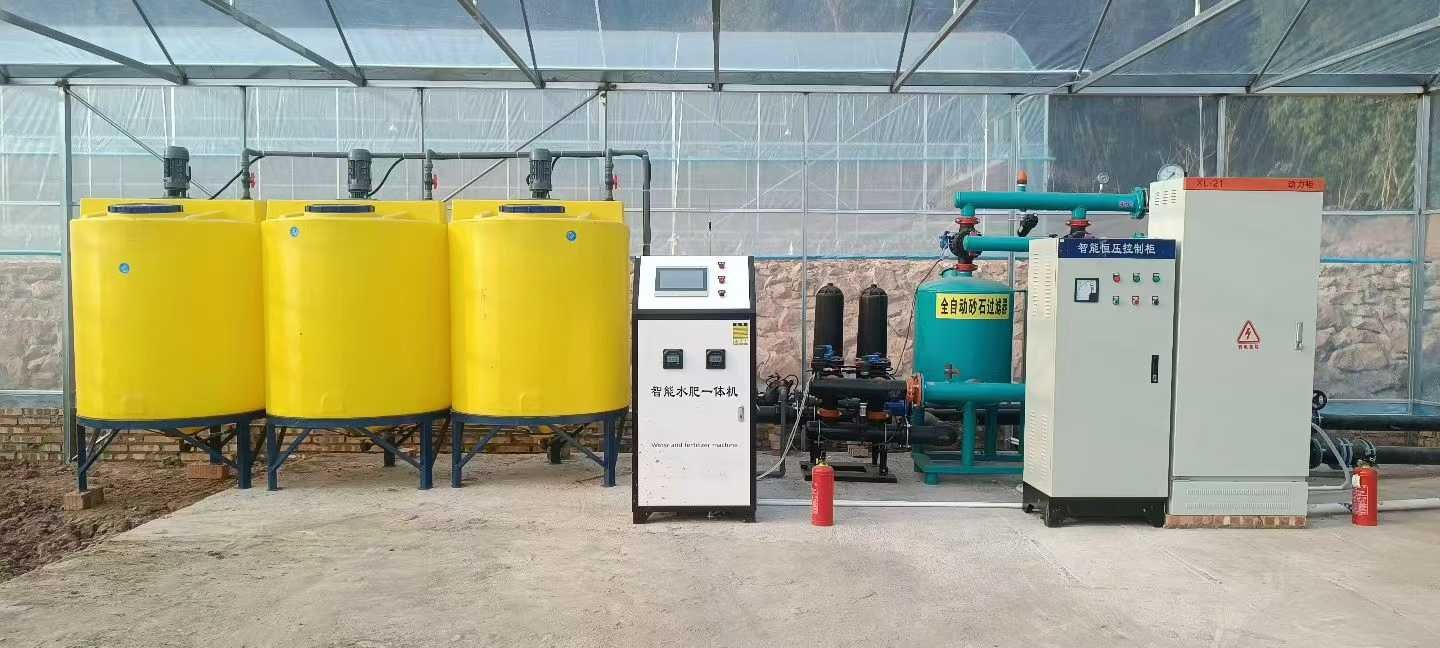
Smart Fertigation System: 5 Common Problems and Solutions
Fertigation — the practice of injecting fertilizers, soil amendments, and other water-soluble products into an irrigation system — has transformed modern agriculture.
When it works well, fertigation helps crops receive the right nutrients at the right time. But like any complex system, a fertigation system can face technical issues that reduce efficiency, crop performance, and ROI.
In this guide, we explore five common fertigation system problems and how a Smart Fertigation System can help farm owners and agronomists prevent faults, simplify repairs, and keep fields running smoothly.
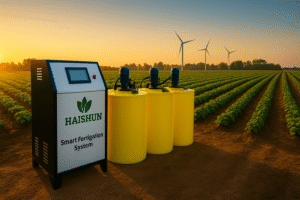
Haishun Smart Fertigation System delivering precise water and nutrients for healthy, uniform crops.
I. Smart Fertigation System: Definition and Importance
A Smart Fertigation System represents a major step forward in precision agriculture. It integrates advanced sensors, automated controls, and data analytics to optimize nutrient delivery through existing irrigation infrastructure.
In practical terms, it acts as an automated nutrient delivery hub that continually responds to real-time field conditions. This capability is especially valuable for preventing irrigation faults, shortening repair time, and protecting yields in large-scale operations.
Definition & Role: In irrigation management, a Smart Fertigation System is an automated platform that:
- Uses real-time data (flow, EC, pH, soil moisture, weather) to adjust fertilizer application.
- Prevents over- or under-fertilization by dosing nutrients precisely where and when they are needed.
- Identifies abnormalities in pressure, flow, and dosing that may indicate system faults.
- Supports faster diagnostics and corrective action to minimize downtime.
Industry Trends & Significance:
The global fertigation market is growing rapidly as growers face pressure to increase yields while protecting water resources and soil health.
Precision agriculture tools, including Smart Fertigation Systems, are becoming essential to meet stricter environmental regulations and rising quality standards.
| Factor | Data / Trend | Smart Fertigation System Impact |
|---|---|---|
| Market Growth | Global fertigation adoption is expected to grow strongly in the coming years as more farms automate irrigation and nutrient delivery. | Drives adoption by offering precise, automated nutrient delivery, lower operating costs, and data transparency. |
| Water Scarcity | Many regions experience chronic water stress, forcing farms to produce more with less water. | Minimizes water use by delivering water and nutrients directly to the root zone, with minimal runoff or evaporation losses. |
| Environmental Concerns | Regulations are tightening around nutrient runoff, leaching, and greenhouse gas emissions from agriculture. | Reduces environmental impact through precise nutrient management, reduced over-application, and better record-keeping. |
| Precision Agriculture | Data-driven farming, variable-rate application, and remote monitoring are becoming standard in commercial operations. | Integrates seamlessly with other smart farming technologies, providing a central hub for irrigation and fertigation analytics. |
For more background on global agriculture and resource constraints, see resources from the
Food and Agriculture Organization (FAO).
II. Core Functions of a Smart Fertigation System
A well-designed Smart Fertigation System, such as the Haishun Smart Fertigation System ,provides several core functions to keep the fertigation process consistent, efficient, and safe.
- Real-time Monitoring: Continuous tracking of key parameters such as soil moisture, EC, pH, and nutrient concentration in the irrigation water,
helping operators understand plant needs hour by hour. - Automated Adjustments: Automatic control of fertilizer injectors, valves, and pumps to maintain the target nutrient recipe for each crop and growth stage.
- Remote Control: Secure remote access allows farm managers and technicians to adjust settings, start or stop irrigation, and review alarms from anywhere.
- Predictive Maintenance: Analytics highlight abnormal patterns (pressure drops, flow deviations, injector performance),
supporting proactive maintenance before breakdowns occur. - Data Logging & Reporting: Detailed data records on irrigation events, fertilizer usage, and system performance make it easier to analyze ROI and comply with audits.
III. Key Considerations When Purchasing a Smart Fertigation System
Buying a Smart Fertigation System is a strategic decision. The right choice should match your farm size, crop types, and long-term automation goals.
- Scalability: The system should handle expansion to more blocks, crops, and irrigation zones without a complete redesign.
- Compatibility: Check that it integrates smoothly with your current irrigation network, pumps, filters, and control systems.
- Ease of Use: A clear, intuitive interface is critical so that field teams can operate it confidently with minimal training.
- Data Analytics: Look for strong reporting and analytics features that translate raw data into clear, actionable insights.
- Reliability & Support: Work with a reputable supplier that provides reliable hardware, software updates, and technical support.
IV. 5 Common Problems in Fertigation Systems & How to Solve Them
Even with good design, fertigation systems can encounter issues over time. Below are five common problems and practical solutions to keep the system running at peak performance.
| Problem | Typical Cause | Solution |
|---|---|---|
| Clogging of Lines | Mineral precipitation, organic matter, or undissolved fertilizer particles accumulating in emitters and pipelines. | Implement a robust filtration system; use high-quality fully soluble fertilizers; acidify water when needed to prevent mineral buildup; schedule regular line flushing and chemical cleaning. |
| Uneven Distribution | Pressure variations, partially blocked emitters, or poorly maintained valves leading to non-uniform flow. | Calibrate pressure regulators regularly; perform distribution uniformity tests; repair leaks and replace worn components; verify that the system is operated within its design flow and pressure range. |
| Fertilizer Incompatibility | Mixing incompatible nutrients (e.g., phosphates with calcium) can cause precipitation and blockages. | Conduct simple “jar tests” before mixing fertilizers; follow agronomic guidelines; use compatible formulations; respect dilution and injection order instructions from suppliers. |
| System Leaks | Aging pipes, loose fittings, or damage from machinery leading to water and nutrient loss. | Perform regular visual inspections; monitor pressure gauges and flow meters for anomalies; repair or replace damaged parts promptly; use durable materials suited to the local environment. |
| Nutrient Runoff & Waste | Over-application, poor scheduling, or inadequate infiltration causing nutrients to wash away or leach. | Fine-tune fertigation schedules based on crop stage and soil data; favor drip or micro-sprinkler systems for precise delivery; use a Smart Fertigation System to avoid over-dosing and document application rates accurately. |
A Smart Fertigation System helps detect many of these problems early — for example, by triggering alarms when pressure, flow, or EC readings fall outside the normal range.
V. Smart Fertigation, Irrigation Faults & System Repair
When irrigation faults occur, response time is critical. A Smart Fertigation System supports both fault prevention and faster repairs in several ways:
- Early Fault Detection: Real-time monitoring and alarms make it easier to spot abnormal pressure, flow, or EC values before they turn into major system failures.
- Remote Diagnostics: Technicians can review logs, alarm histories, and real-time sensor data remotely, allowing them to arrive on site with the right parts and tools.
- Automated Shutdown: Safety rules can be configured so the system automatically stops dosing fertilizers or shuts down irrigation in the event of critical faults,
preventing expensive damage and crop burn. - Data-Driven Repairs: Historical data helps identify the root cause of recurring problems and supports smarter long-term design improvements.
VI. Conclusion & Why Work with Haishun
Addressing common fertigation system problems proactively is essential for protecting yields, lowering input costs, and meeting sustainability goals.By combining good design, regular maintenance, and smart automation, farms can keep irrigation and fertigation systems running reliably season after season.
For growers seeking a robust solution, the Haishun Smart Fertigation System provides advanced monitoring, automated dosing, and data-driven insights that make it easier to prevent faults and streamline repairs.
Partnering with Haishun offers several advantages:
- Smart System Design: Solutions tailored to local water quality, crops, and climate, integrating filters, injectors, and control units into one coherent Smart Fertigation System.
- Proven Export Experience: Experience serving commercial farms across the Middle East, Southeast Asia, Africa, and Latin America with reliable equipment and logistics support.
- Focus on ROI: System configurations designed to improve water- and fertilizer-use efficiency, reduce labor, and shorten payback periods for farm owners.
- Technical Support & Training: Guidance on installation, commissioning, and day-to-day operation to help teams get the most from smart fertigation.
- Sustainable Agriculture Mindset: Haishun products are built around efficient resource use, soil health, and long-term productivity.
By integrating these best practices and leveraging modern Smart Fertigation Systems, farms can move toward higher yields, more stable quality, and a more sustainable future.
VII. FAQ: Common Fertigation System Questions
1. What causes fertigation system clogging?
Clogging is usually caused by mineral precipitation (such as calcium carbonate), organic matter, algae, or undissolved fertilizer particles.
Proper filtration, water treatment, and the use of fully soluble fertilizers are key to preventing blockages in Smart Fertigation Systems.
2. How does a Smart Fertigation System save water and fertilizer?
A Smart Fertigation System applies water and nutrients only when and where they are needed, based on real-time data.
This reduces waste from over-irrigation and over-application, helping farms achieve higher productivity with fewer inputs.
3. Is a Smart Fertigation System suitable for small farms?
While many smart systems are designed for large commercial farms, modular designs and scalable configurations can also work well for mid-sized or high-value specialty crops.
A technical evaluation can help determine the best setup for your farm size and budget.
4. What makes Haishun’s Smart Fertigation System different?
Haishun combines durable hardware, user-friendly software, and strong export support.
The Smart Fertigation System is built for real-world farm conditions and designed to integrate with drip irrigation, greenhouses, and open-field applications.