How to Choose Smart Fertigation Systems (5 Key Steps)
Table of Contents
Introduction & Background
For many growers, water, fertilizer, and labor are the three biggest production costs. Smart Fertigation Systems address all three at the same time by delivering water and nutrients together in a controlled, automated way. Instead of relying on manual mixing, guessing fertilizer amounts, or running pumps on fixed schedules, farmers can use data and sensors to apply exactly what the crop needs, when it needs it.
When designed correctly, Smart Fertigation Systems help stabilize yield, reduce nutrient losses, and support long-term soil and water sustainability. They are now widely used in open-field vegetables, orchards, greenhouses, and even high-value crops such as berries and grapes.
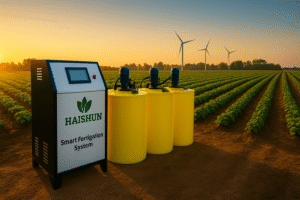
Haishun Smart Fertigation System – Field Demo Unit
What Are Smart Fertigation Systems?
A Smart Fertigation System is an automated unit that mixes, measures, and injects fertilizers into the irrigation line based on sensor data and programmed recipes. It constantly monitors parameters such as EC and pH, adjusting the injection rate to keep the solution within the target range. In drip irrigation projects, a well-matched system guarantees that every emitter along the line delivers water and nutrients in the same proportion.
Compared with conventional manual fertigation, Smart Fertigation Systems reduce human error, avoid over- or under-fertilization, and cut the risk of localized salt stress. Over a full season, this translates into healthier roots, stronger plant growth, and more predictable harvest volumes.
Industry Trends & Significance
Global reports from the FAO highlight water scarcity and fertilizer efficiency as key challenges for agriculture. This is one of the main reasons why Smart Fertigation Systems are expanding rapidly in both developed and emerging markets. Growers are under pressure to produce more with less water and to meet stricter environmental regulations on nutrient runoff.
Haishun supports this trend by integrating IoT sensors, cloud platforms, and data dashboards into Smart Fertigation Systems. This gives farm managers real-time visibility of irrigation performance and allows them to fine-tune fertigation strategies across multiple blocks and crops.
Core Functionalities of Smart Fertigation Systems
Although designs differ by supplier, most Smart Fertigation Systems share several core functions that are critical for modern farms:
- Real-time monitoring: Continuous EC, pH, flow, and sometimes soil-moisture measurement.
- Automated dosing: Pumps controlled by algorithms to inject the exact amount of fertilizer required.
- Recipe management: Multiple nutrient formulas for different crops, stages, or blocks.
- Remote access: Control and adjustment via cloud dashboard or mobile app.
- Data logging & analytics: Historical records to analyze yield response and optimize future programs.
When all of these features work together, Smart Fertigation Systems move fertigation from “rule of thumb” to measurable, repeatable precision agriculture.
5 Key Steps to Choose the Right System
- Clarify your crops and targets: List the crops, expected planted area, and yield goals. Make sure the Smart Fertigation System can handle the number of zones and the nutrient recipes required.
- Check hydraulic compatibility: Confirm that the system matches your mainline diameter, operating pressure, and total flow. A well-designed system will not restrict irrigation capacity.
- Define automation and connectivity level: Decide whether you need only local control or full cloud-based Smart Fertigation Systems with remote access, alarms, and integration with weather or soil sensors.
- Calculate payback period: Consider savings in fertilizer, labor, and water, plus potential yield increase. Many growers see Smart Fertigation Systems pay for themselves within 12–18 months.
- Work with an experienced partner: A supplier like Haishun can design the layout, pre-assemble units, provide commissioning on site, and train your team for long-term, reliable operation.
Main Components
Understanding the main hardware parts of Smart Fertigation Systems helps you compare offers and identify where quality matters most:
| Component | Function | Benefit |
|---|---|---|
| Fertilizer Tanks | Store concentrated nutrient solutions. | Allow flexible formulation and easy refilling. |
| Injection Pumps | Inject fertilizer into the irrigation line. | Provide accurate, repeatable dosing rates. |
| Filters | Remove particulates before water enters the system. | Protect emitters and reduce clogging risk. |
| Control Unit | Reads sensors and manages dosing logic. | Maintains stable EC and pH, even when conditions change. |
Common Problems & Solutions
Even high-quality Smart Fertigation Systems require proper operation and regular maintenance. Below are some typical issues and how to avoid them:
- Clogging: Always use adequate filtration and flush lines after fertigating, especially when using organic products.
- Uneven distribution: Check pressure regulators, valve settings, and block design to keep flow as uniform as possible.
- Sensor drift: Calibrate EC and pH probes monthly to ensure accurate readings and nutrient balance.
- Power interruptions: Consider UPS or solar backup so the Smart Fertigation System can complete its cycle without interruption.
FAQ
Q: How do Smart Fertigation Systems save water?
A: They deliver water directly to the root zone at controlled rates, reducing evaporation and runoff compared with traditional surface irrigation.
Q: What is the typical ROI?
A: Many farms achieve payback within 12–18 months through fertilizer savings, lower labor costs, and more stable yields.
Q: Can Smart Fertigation Systems work with existing drip lines?
A: Yes. In most cases the fertigation skid is installed on the mainline and connected to your current drip or sprinkler network.
Q: Are Smart Fertigation Systems suitable for greenhouses?
A: They are widely used in greenhouses, where precise control of EC, pH, and irrigation timing is essential for high-value crops.
Q: What support does Haishun provide?
A: Haishun offers system design, on-site commissioning, remote technical support, and long-term spare-parts supply for Smart Fertigation Systems.