Drip Irrigation Tape for Peppers: Spacing, Flow Rate and Installation Guide
Everything pepper farmers, farm operators, and procurement managers need to know about drip tape for peppers — the right emitter spacing, wall thickness, flow rate, and installation sequence for consistent export-grade fruit production.
Focus keyword: drip tape for peppers · Updated: May 2026 · Reading time: ~8 min
▶ Quick Answer: Recommended Spec
The standard specification for drip tape for peppers in commercial export production is: 16mm tube, 0.18mm wall thickness, 20–30cm emitter spacing, 1.0–1.38 L/h flow rate, 100% virgin LLDPE. This combination provides the flow uniformity peppers require for consistent fruit sizing, withstands 1–2 growing seasons under open-field UV conditions, and is compatible with fertigation systems for combined water and nutrient delivery. For high-UV regions — including Mexico’s northern agricultural states — upgrade to 0.20mm wall thickness.
Why Drip Tape Selection Matters for Pepper Yield
Peppers are more sensitive to irrigation inconsistency than most field crops. The root system is shallow and concentrated — the majority of active roots sit within the top 20–30cm of soil, directly in the moisture zone created by drip tape. When that moisture zone varies across a row, the consequences are visible and financially measurable.
The two most common quality problems in commercial pepper production that trace back to drip tape for peppers selection are blossom end rot (caused by inconsistent calcium uptake linked to moisture variation) and uneven fruit sizing (which reduces the proportion of export-grade fruit per hectare). Both are directly connected to irrigation uniformity — and irrigation uniformity is directly connected to emitter design.
The practical implication: Choosing the wrong drip tape for peppers — or the right tape with incorrect spacing — does not just affect yield volume. It affects the proportion of marketable Grade A fruit, which is where export value is concentrated.
What Different Buyers Actually Care About
The decision about drip tape for peppers looks different depending on the scale of operation and the buyer’s role in the supply chain.
🌶️ Commercial Pepper Farms (50–500 ha)
Scale changes the stakes. A 1% reduction in export-grade fruit across 100 hectares of peppers is a significant revenue loss per season. These buyers need spec consistency across every batch ordered — same wall thickness variance, same emitter output — because they cannot afford to re-test tape mid-season.
They need: Confirmed 0.18mm or 0.20mm spec, batch test certificates, and a supplier who can fulfill repeat orders at identical specification.
🌍 Regional Distributors (Latin America)
Distributors serving pepper-growing regions in Mexico, Peru, and Colombia carry the reputation risk when tape fails in their customer’s field. They need to know that the drip tape for peppers they stock is spec-verified — not just claimed. One field failure from an unverified supplier affects their entire regional customer base.
They need: Raw material certificates, lot traceability, and a supplier who responds within one business day when a field issue is reported.
📋 Agronomy Consultants & EPC Contractors
Irrigation system designers specify drip tape for pepper projects based on soil type, water quality, and farm layout. Their reputation depends on the tape performing as specified. They need reliable technical data — not marketing claims — to justify their specification decisions to farm owners and project clients.
They need: Verified emitter output data, system design support, and documentation they can include in project handover packages.
👨🌾 Independent Pepper Farmers (1–20 ha)
Smaller operators often rely on local distributor advice or online research to make drip tape decisions. They are most at risk of underspecifying — choosing 0.15mm tape or labyrinth tape because it is cheaper, then losing yield quality in the process. A clear recommendation from a credible source saves them from a costly mistake.
They need: A straightforward spec recommendation, a simple quantity calculation, and a contact they can reach with a question before placing an order.
Emitter Spacing, Flow Rate & Wall Thickness for Peppers
Emitter Spacing
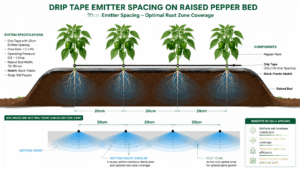
The most common mistake with drip tape for peppers is using 30cm emitter spacing when the crop and soil type require 20cm. The correct spacing depends on three factors: in-row plant spacing, soil texture, and whether the tape is used under plastic mulch.
- 20cm spacing: Standard recommendation for most pepper varieties at 40–50cm in-row plant spacing. Provides overlapping wetting fronts on sandy and loamy soils.
- 30cm spacing: Acceptable for wider plant spacing (60–70cm) or clay soils with higher lateral water movement. Reduces tape cost per hectare.
- 15cm spacing: Used in high-density greenhouse pepper systems or where water quality is very high and precise moisture control is required.
Flow Rate
The recommended flow rate for drip tape for peppers is 1.0–1.38 L/h per emitter. This range delivers adequate moisture to the root zone without surface saturation, which would promote Phytophthora and other stem-base fungal diseases that affect pepper crops.
Why flow rate matters for disease management: Flow rates above 2.0 L/h on lighter soils can cause localized surface pooling near the stem base — a primary risk factor for stem rot in peppers. Specifying 1.0–1.38 L/h keeps the wetting pattern subsurface and away from the stem.
Wall Thickness
Wall thickness determines how many seasons the tape performs. For open-field pepper production with plastic mulch:
- 0.18mm: Standard export specification, suitable for 1–2 seasons in most pepper-growing regions.
- 0.20mm: Recommended for high-UV environments — northern Mexico, arid growing regions — or where the tape is exposed to direct sun between seasons.
- 0.15mm: Not recommended for peppers. The thinner wall degrades faster under UV exposure and is more susceptible to puncture during mulch installation.
Drip Tape for Peppers: Full Specification Table
| Parameter | Standard (Open Field) | High-UV / Arid Regions | Greenhouse |
|---|---|---|---|
| Tape type | Flat Emitter | Flat Emitter | Flat Emitter |
| Tube diameter | 16mm | 16mm | 16mm |
| Wall thickness | 0.18mm | 0.20mm | 0.15–0.18mm |
| Emitter spacing | 20–30cm | 20–30cm | 15–20cm |
| Flow rate | 1.0–1.38 L/h | 1.0–1.38 L/h | 1.0 L/h |
| Raw material | 100% virgin LLDPE | 100% virgin LLDPE | 100% virgin LLDPE |
| Expected service life | 1–2 seasons | 2–3 seasons | 2–3 seasons |
| Fertigation compatible | Yes — with soluble fertilizers | Yes | Yes |
| Filtration required | 120-mesh minimum | 120-mesh minimum | 120-mesh minimum |
Reference: FAO Irrigation and Drainage guidelines.
For specifications and availability, contact our team.
Step-by-Step Installation Guide
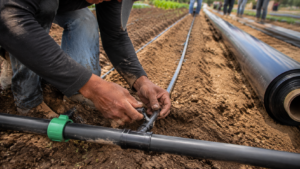
The following installation sequence applies to commercial pepper production under plastic mulch, which is the dominant system in Latin American and Mediterranean pepper-growing regions.
1
Prepare raised beds and lay sub-lateral pipes
Form beds to the required width (typically 80–120cm) and install sub-lateral supply pipes along the bed perimeter. Ensure the sub-lateral is adequately flushed before connecting drip tape.
2
Connect drip tape to sub-laterals
Use barbed fittings of the correct diameter (16mm for standard drip tape). Ensure the connection is secure without over-tightening, which can partially obstruct flow at the entry point. For peppers grown as double rows per bed, install two parallel tape runs per bed.
3
Lay tape with emitters facing up
For drip tape for peppers installed under plastic mulch, the emitters should face upward (12 o’clock position) to direct output into the soil above the tape. Avoid tension on the tape — lay it with slight slack to allow for thermal expansion.
4
Install end caps and flush the system
Before covering with mulch, flush the entire drip tape run by opening the end caps and running water through the system for 2–3 minutes per run. This clears installation debris that would otherwise clog emitters during the first irrigation.
5
Cover with plastic mulch film
Lay black or silver-black mulch film over the tape runs. Ensure the film is anchored securely at the bed edges to prevent wind lifting that would expose the tape to UV and physical damage.
6
Make planting holes and verify pressure
After mulch installation, make planting holes at the specified plant spacing. Before transplanting, run the irrigation system at target operating pressure and check for uniform drip output along the entire run. Address any non-dripping emitters before transplanting — it is significantly harder to locate and fix blockages after the crop is established.
For systems combining drip irrigation with fertilizer delivery, see our smart fertigation system
— designed to work with flat emitter drip tape for precision nutrient application in pepper and vegetable production.
How Many Meters of Drip Tape Per Hectare of Peppers?
The required quantity of drip tape for peppers depends on your row spacing and field dimensions. Use the formula below to calculate your project requirement accurately.
📐 Calculation Formula
Total meters = (Field width ÷ Row spacing) × Field length × 1.10
1.10 = 10% buffer for connections, flushing ends, and terrain variation. All values in meters.
| Pepper Bed Configuration | Row Spacing | Field Length | Approx. Total / Hectare |
|---|---|---|---|
| Single row, wide spacing | 0.70 m | 100 m | ≈ 15,700 m |
| Single row, standard | 0.50 m | 100 m | ≈ 22,000 m |
| Double row on 1.2m bed | 0.30 m (per row) | 100 m | ≈ 36,700 m × 2 runs |
| Greenhouse rows, dense | 0.40 m | 50 m | ≈ 13,750 m |
Based on 100m × 100m field (standard layout). For irregular fields or double-row beds, contact us for a project-specific quantity estimate →
5 Common Mistakes With Drip Tape for Peppers
These are the most frequently encountered problems in commercial pepper irrigation systems — most of which trace back to specification or installation decisions made before the crop goes in the ground.
- Using labyrinth tape for export-grade production. The output variance of labyrinth tape (up to 10%) is visibly detectable in fruit sizing by mid-season. Flat emitter tape is the correct specification for any pepper production where grading consistency matters.
- Specifying 30cm emitter spacing on sandy soil. Sandy soils have low lateral water movement — the wetting front from each emitter is narrower than in loamy or clay soils. 30cm spacing on sandy soil can leave dry zones between emitters, particularly at the extremes of each irrigation cycle. Use 20cm on sandy profiles.
- Installing tape without pre-flushing. Plastic particles and dust from tape manufacturing and installation accumulate inside the tube. Without pre-flush, the first irrigation pushes this debris into the emitters. Once emitters are clogged under mulch, the only solution is to lift the mulch — which damages the crop.
- Choosing 0.15mm tape for cost savings. The wall thickness difference between 0.15mm and 0.18mm represents a small cost difference per meter. Over a full pepper season in a sun-exposed open field, 0.15mm tape degrades noticeably — increasing leakage risk and reducing pressure uniformity by season end.
- Neglecting end-of-season acid flushing. Mineral deposits from irrigation water accumulate inside emitters over a growing season. Without an acid flush (typically dilute phosphoric acid) at season end, deposits harden and reduce output in subsequent seasons. For buyers intending to reuse tape, this maintenance step determines whether a second season is viable.
See our complete guide on flat emitter vs labyrinth drip tape for a broader comparison of tape types across different crops and project requirements.
Full product specifications on our drip irrigation tape product page.
Need drip tape for your pepper farm or project?
Whether you need a specification recommendation, a quantity estimate for your farm layout, or certification documentation for a project tender — our team responds within one business day.
Frequently Asked Questions
Latin America Farming Smart Farming Water Saving