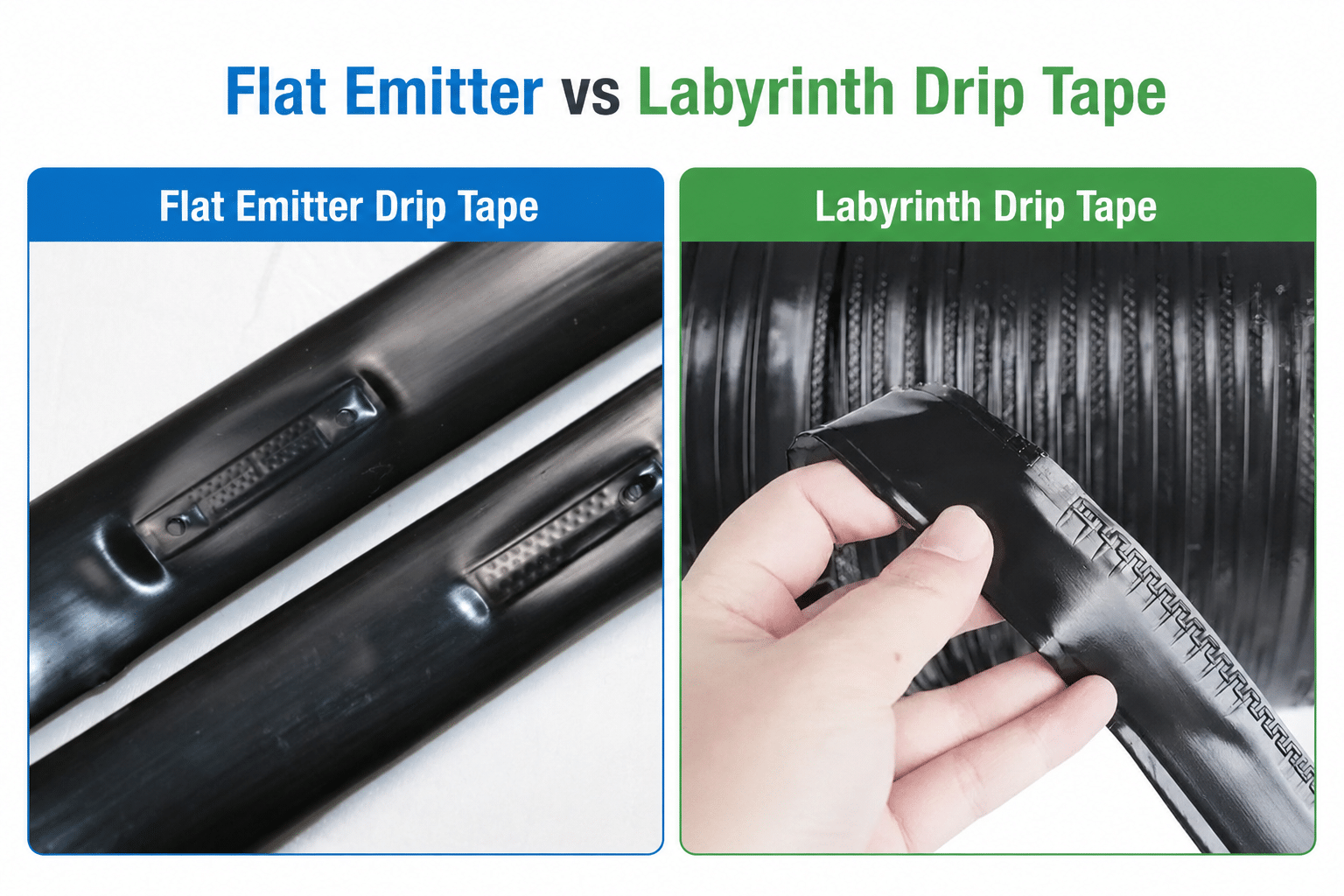
Flat Emitter vs Labyrinth Drip Tape: Which Is Better for Your Farm?
A practical buyer’s guide — what actually matters when choosing between flat emitter and labyrinth drip tape: crop fit, wall thickness, lifespan, and what distributors and procurement managers need to verify before placing an order.
Focus keyword: flat emitter vs labyrinth drip tape · Updated: May 2026 · Reading time: ~8 min
▶ Quick Answer
When comparing flat emitter vs labyrinth drip tape, the decision comes down to two things: what you are growing, and how long the installation needs to last. Flat emitter tape delivers better flow consistency and clog resistance — the right choice for peppers, strawberries, tomatoes, and any export-grade crop. Labyrinth tape costs less per meter and works well for single-season field crops like corn and sugarcane where input cost drives every decision. Both types are available in virgin LLDPE from 0.15mm to 0.40mm wall thickness.

What Different Buyers Actually Care About
The flat emitter vs labyrinth drip tape decision looks different depending on who is making it. Here is what actually drives the choice for each buyer type.
🏭 Large Farm Operators
The question is not which tape is cheaper per meter — it is which tape costs less per ton of Grade A fruit. A 5–10% output variation (typical with labyrinth tape) translates directly to a measurable drop in export-grade yield. For farms running peppers, strawberries, or tomatoes at scale, flat emitter tape is the standard.
They need: Spec stability across large orders, crop-matched wall thickness, and a supplier who can hold consistent roll specifications batch to batch.
🌍 International Distributors
For top-tier distributors switching suppliers, the biggest risk is not price — it is the liability of recommending a product that fails in the field. A distributor stocking both flat emitter and labyrinth drip tape needs to know the product received in February matches the product received in August.
They need: Lot traceability, raw material certificates, pre-shipment inspection reports, and certifications ready for tender submissions.
📋 EPC & Project Procurement
In government-funded irrigation projects — common across the Middle East and Latin America — the flat emitter vs labyrinth drip tape decision is often already specified in the tender. The procurement team’s job is finding a supplier who can prove compliance and deliver on schedule. Certification gaps are contractual liabilities.
They need: Full certification package, declared production capacity, and payment terms compatible with project cash flow cycles.
👨🌾 Independent Farm Owners
The most likely buyer to make a costly mistake — choosing 0.15mm labyrinth tape for strawberries because it was the cheapest option available. They need a clear answer: which type for their crop, which wall thickness for their climate, and how much to order without over-buying.
They need: A crop-specific recommendation, a simple quantity calculation, and a responsive contact they can reach directly.
Flat Emitter vs Labyrinth Drip Tape: What the Difference Means in Practice
Both flat emitter and labyrinth drip tape deliver water directly to the root zone. The difference is in how each type controls the flow — and that difference has real consequences for field performance and sourcing risk.
Flat Emitter Tape
Individual disc emitters are manufactured separately and welded into the tube wall. Each emitter has its own built-in screen and flow path, producing consistent output even when water quality varies.
In practice: lower clogging risk, consistent delivery across the full run, longer service life, higher upfront investment per meter.
Labyrinth Drip Tape
The flow channel is molded into the tube wall during extrusion — no separate emitter component. Lower manufacturing cost means a lower price per meter, but the open channel is more sensitive to sediment and mineral buildup.
In practice: lower cost per meter, adequate for single-season crops, requires disciplined filtration management, more output variation over run length.
The bottom line: When choosing between flat emitter vs labyrinth drip tape, the question is not which tape is technically superior — it is which tape is appropriate for your crop value, water source, and installation timeline. Flat emitter tape is the default where field performance affects revenue. Labyrinth tape is the default where cost per hectare is the dominant variable.
Flat Emitter vs Labyrinth Drip Tape: Full Comparison
| Comparison Point | Flat Emitter Tape | Labyrinth Drip Tape |
|---|---|---|
| Output consistency | ★★★★★ Less than 5% variance across full run | ★★★☆☆ Up to 10% variance possible |
| Clog resistance | High — built-in screen at each emitter | Moderate — 120-mesh head filter required |
| Wall thickness range | 0.15–0.40mm; export standard: 0.18mm | 0.15–0.30mm; most common: 0.15mm |
| Expected lifespan | 3–5 seasons (0.20mm+ virgin LLDPE) | 1 season (0.15mm); 2–3 seasons (0.20mm) |
| Supplier documentation | ISO 9261, raw material certificate, output test data | ISO 9261, raw material certificate |
| Raw material | 100% virgin LLDPE required | Virgin LLDPE recommended; blended acceptable for single season |
| Best application | Peppers, strawberries, tomatoes, orchards | Corn, sugarcane, cotton, field vegetables |
Reference: FAO Irrigation and Drainage.
For specifications and availability, contact our team directly.
Which Tape for Which Crop?

| Crop | Tape Type | Recommended Spec | Key Reason |
|---|---|---|---|
| 🌶️ Peppers | Flat Emitter | 16mm · 0.18mm · 20–30cm · 1.0–1.38 L/h | Uniform fruit sizing for export grading |
| 🍓 Strawberries | Flat Emitter | 16mm · 0.15–0.18mm · 10–20cm · 1.0 L/h | Shallow roots, highest uniformity required |
| 🍅 Tomatoes | Flat Emitter | 16mm · 0.18–0.20mm · 20–30cm · 1.38 L/h | Export grade consistency, fertigation use |
| 🌽 Corn / Maize | Labyrinth | 16mm · 0.15–0.18mm · 40cm · 1.5–2.0 L/h | Cost per hectare is the primary driver |
| 🌿 Sugarcane | Labyrinth | 16mm · 0.15–0.18mm · 40cm · 2.0–3.0 L/h | High flow demand, large-scale planting |
| 🍇 Orchards | Flat Emitter | 16–20mm · 0.20–0.25mm · 30–50cm · 2.0 L/h | Multi-year installation, durability priority |
For crops combining drip tape with soluble fertilizer delivery, pairing with a
smart fertigation system
maximizes input efficiency. Full specifications on our
drip irrigation tape product page.
Wall Thickness: 0.15mm vs 0.18mm vs 0.20mm
Wall thickness determines how long the tape lasts under UV exposure, mechanical stress during installation, and soil abrasion. It is the most consequential specification decision in any flat emitter vs labyrinth drip tape sourcing process — and the one most frequently underspecified.

| Thickness | Seasons | Best Application | Specification Note |
|---|---|---|---|
| 0.15 mm | 1 season | Corn, sugarcane — flat terrain, cost-driven projects | Single-use only; not suitable for UV-exposed multi-season use |
| 0.18 mm | 1–2 seasons | Peppers, tomatoes, vegetables — most common export spec | Default specification for most B2B buyers; best durability-to-investment balance |
| 0.20 mm | 2–3 seasons | Strawberries, orchards, high-UV regions | Required for northern Mexico, Jordan Valley, Saudi Arabia arid projects |
| 0.25–0.40 mm | 3–5 seasons | Permanent orchard systems, multi-year greenhouse | Long-term infrastructure; specify with site-specific UV and pressure data |
What buyers should know: Wall thickness uniformity varies significantly between suppliers. A wall measuring 0.15mm at one point and 0.11mm at another is a failure risk, not a specification. Always request measurement data across a full roll — 5 points minimum — before approving any new supplier or new production batch.
How Many Meters of Drip Tape Per Hectare?
There is no fixed answer — the correct quantity depends entirely on your row spacing and field length. Use the formula below for a precise project estimate.
📐 Calculation Formula
Total meters = (Field width ÷ Row spacing) × Field length × 1.10
1.10 accounts for a 10% buffer — connections, flushing ends, and terrain variation. All values in meters.
| Crop | Row Spacing | Field Length | Approx. Total / Hectare |
|---|---|---|---|
| Strawberries | 0.30 m | 100 m | ≈ 36,700 m |
| Peppers | 0.50 m | 100 m | ≈ 22,000 m |
| Tomatoes | 0.60 m | 100 m | ≈ 18,300 m |
| Corn | 0.75 m | 100 m | ≈ 14,700 m |
| Sugarcane | 1.00 m | 100 m | ≈ 11,000 m |
Based on a 100m × 100m field layout. For large or irregular fields, contact us for a full quantity estimate →
5 Things to Verify When Sourcing Drip Tape
Whether you are deciding between flat emitter vs labyrinth drip tape or comparing suppliers, these are the five verification points experienced procurement managers use to separate reliable suppliers from risky ones.
- Virgin LLDPE raw material certificate. Request an SGS or Bureau Veritas test report. “High-quality PE” without a test certificate is not verifiable. Virgin material provides the UV resistance and tensile strength needed for multi-season use; blended material fails faster and cannot be distinguished visually from virgin stock.
- Wall thickness measurement data. Request caliper readings at minimum 5 points per 100m roll. Variance above ±0.015mm indicates inconsistent extrusion — the most common cause of early field failure. This is the most practical quality check available before the tape reaches your project site.
- Batch-to-batch consistency. For repeat orders, request that the second batch matches the first on wall thickness and roll weight. Roll weight is a reliable proxy for material density — a measurable variance between orders indicates material substitution.
- Market-relevant certifications. ISO 9261 for general export. SASO for Saudi Arabia. ASTM D451 for North America. Confirm the factory holds the certification itself — not a shared or borrowed certificate — which is a meaningful distinction for government tender submissions and EPC contract compliance.
- Container loading and lead time confirmation. A standard 40HQ container holds approximately 900–1,300 rolls of 16mm drip tape depending on wall thickness and roll length. Confirm roll length (standard export: 2,000m/roll), total carton count, and gross weight — container weight limits are typically reached before volume limits for drip tape shipments.
View our full product range or contact us for samples, certification documents, and project quotations.
See also: FAO irrigation design guidelines.
Need a specification or sourcing recommendation?
Whether you are comparing flat emitter vs labyrinth drip tape for your crop, planning a large-volume order, or need certification documentation for a project tender — our team responds within one business day.