Commercial Hydroponic Systems: 2026 Guide to Types, Components & Setup
Target keyword: commercial hydroponic systems ·
Table of Contents
- I. What Are Commercial Hydroponic Systems?
- II. Main Types of Commercial Hydroponic Systems
- III. Essential Components of Commercial Hydroponic Systems
- IV. Automation, Monitoring & Scalability
- V. Suitable Crops & Use Cases
- VI. Planning, ROI & Investment Considerations
- VII. How Haishun Supports Commercial Hydroponic Systems
- VIII. FAQs
Short Excerpt
Commercial hydroponic systems help growers achieve stable yields and consistent quality by controlling the root-zone and climate. This guide covers system types, facility components, automation, crop selection, and ROI planning for greenhouse projects.
Struggling with unstable yields, water shortages, or inconsistent quality? Commercial hydroponic systems move production into controlled environments and turn agriculture into a predictable, data-driven business.
Instead of relying on soil and rainfall, you design the root-zone and climate around what crops need—nutrients, oxygen, and stable setpoints delivered with precision.
For operators chasing profit stability, the big value is consistency: fewer quality rejects, fewer emergency interventions, and clearer production forecasting week by week.
I. What Are Commercial Hydroponic Systems?
A commercial hydroponic system is a large-scale growing setup that cultivates crops without soil by delivering nutrient-rich water directly to plant roots. Crops grow in channels, troughs, or containers filled with inert media or circulating water.
Well-designed commercial hydroponic systems integrate irrigation, fertigation, climate control, lighting, and monitoring into one facility, enabling:
- Year-round production independent of seasons
- Higher yield per square meter than field farming
- Reduced water loss via recirculation strategies
- More consistent quality for retail and export programs
In arid or saline regions, pairing hydroponics with water treatment and precision controls can unlock stable production where conventional agriculture struggles.
II. Main Types of Commercial Hydroponic Systems
Selecting the right type of commercial hydroponic system depends on crops, climate, operating skills, and desired automation level.
1) Drip Systems
Drip-based commercial hydroponic systems use pressure-compensated emitters to deliver nutrient solution to each plant. They are popular for tomatoes, cucumbers, peppers, and berries, with flexible zoning for different EC/pH recipes.
2) Nutrient Film Technique (NFT)
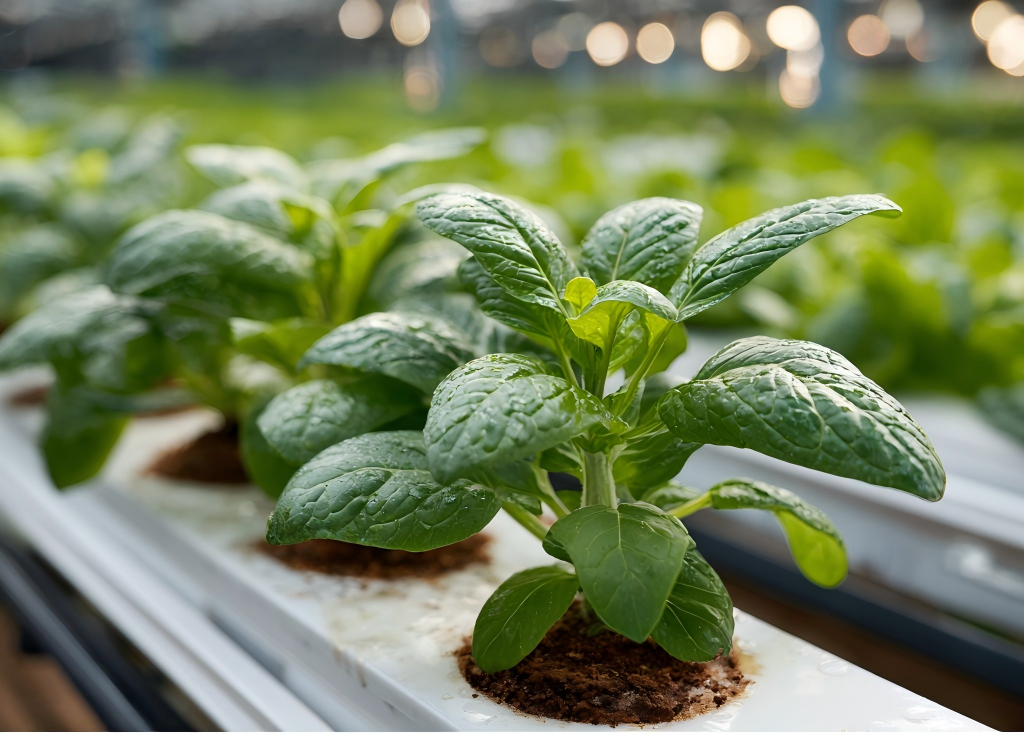
NFT commercial hydroponic systems recirculate a shallow nutrient film through channels so roots receive water, nutrients, and oxygen simultaneously—ideal for leafy greens and herbs.
3) Ebb & Flow (Flood & Drain)
Ebb & Flow systems flood trays on a schedule and drain back to a reservoir. They provide strong aeration and operational buffering, often used in nurseries and ornamentals.
4) Deep Water Culture (DWC)
DWC commercial hydroponic systems suspend roots in aerated nutrient tanks. They suit leafy greens and bench/container farms, where oxygenation and hygiene control root disease risk.
5) Aeroponics
Aeroponics mists roots in the air for high growth rates and is used for propagation and high-value crops. It delivers performance but requires stronger redundancy and technical management.
| System Type | Best For | Operational Notes |
|---|---|---|
| Drip | Fruiting crops (tomato, cucumber, pepper) | Flexible zoning; strong fertigation management |
| NFT | Leafy greens & herbs | Stable flow & slope control; hygiene critical |
| Ebb & Flow | Nursery, ornamentals | Good buffering; simple mechanics |
| DWC | Leafy greens | Requires aeration; manage biofilm |
| Aeroponics | Propagation, high-value crops | Higher risk; redundancy + alarms required |
III. Essential Components of Commercial Hydroponic Systems
High-performing commercial hydroponic systems depend on a few core modules working reliably together:
- Growing structure: greenhouse, vertical racks, or containers
- Root-zone hardware: channels, gutters, slabs, tanks, or media
- Nutrient delivery: pumps, filters, valves, and distribution lines
- Dosing & control: EC/pH sensors, dosing pumps, controllers
- Water treatment: filtration and RO for hardness/salinity control
- Climate control: ventilation, fans, cooling pads, heating/CO2
- Lighting: LED for indoor or seasonal supplementation
Many operators standardize nutrient mixing with a smart fertigation system to reduce manual labor and dosing errors.
If you want more controlled-environment tips, browse the Haishun blog for practical guides and project notes.
For broader guidance on sustainable controlled-environment production, reference:Food and Agriculture Organization (FAO).
IV. Automation, Monitoring & Scalability
Automation is where commercial hydroponic systems separate from hobby setups. Controls and alarms allow a small team to manage large areas safely and consistently.
- Automatic EC and pH dosing based on crop recipes
- Climate controllers coordinating fans, vents, and cooling pads
- Data logging dashboards to track trends and performance
- Remote access for alarms, setpoints, and quick adjustments
For risk control, define a “minimum redundancy set” early: backup pumps, spare sensors, and basic power protection to reduce downtime impact.
V. Suitable Crops & Use Cases
A wide range of crops perform well in commercial hydroponic systems. Match crop choices with local demand and operational capability.
- Leafy greens & herbs: lettuce, spinach, basil (NFT/DWC)
- Fruiting vegetables: tomato, cucumber, pepper (drip)
- Berries: strawberry programs in stacked gutters
- Seedlings: uniform starts for open-field and orchard planting
If your project targets premium retail, quality consistency and delivery rhythm usually decide the margin more than peak yield.
VI. Planning, ROI & Investment Considerations
Before investing in commercial hydroponic systems, validate the business logic—not just the technology.
- Market: buyer channels, target price, volume commitments
- Site & utilities: power stability, water quality, access roads
- Budget & payback: realistic CAPEX/OPEX and ROI expectations
- Operations: training plan, spare parts, local support
- Risk control: backup power, redundant pumps, emergency SOP
ROI logic (simple but practical)
- Revenue uplift: more sellable grade, stable weekly supply, better contract pricing
- Cost reduction: less water waste, fewer nutrient mistakes, lower labor per kg output
- Risk reduction: fewer climate shocks, fewer field failures, clearer production forecasts
VII. How Haishun Supports Commercial Hydroponic Systems
Haishun supports growers and project developers in designing commercial hydroponic systems matched to local climate, water quality, and market goals—focusing on integrated solutions rather than isolated components.
- System selection (NFT, drip, DWC, or hybrid)
- Greenhouse structure and hydroponic layout planning
- Smart fertigation + filtration packages for EC/salinity conditions
- Bill of materials, budgeting, phased investment roadmap
- Remote installation guidance and early-stage agronomic support
If you prefer a structured discussion, use the contact page to share crop, area, water quality, and target production plan.
Planning a new facility or upgrading existing commercial hydroponic systems? Share your crop, climate, water report, and target area.
Visit Haishun or contact us via email.
VIII. FAQs
1) How much do commercial hydroponic systems cost?
Cost depends on scale, greenhouse structure, automation level, and water treatment needs. Pilots can start modestly, while export-oriented facilities require higher CAPEX. Design should match market price and payback targets.
2) Are commercial hydroponic systems suitable for hot or dry climates?
Yes. With shading, cooling pads, ventilation strategy, and water treatment, commercial hydroponic systems can deliver stable production even in harsh climates where open-field farming is risky.
3) Which commercial hydroponic system type is best for beginners?
Many beginners start with NFT for leafy greens or drip systems for fruiting crops because both have proven commercial references, easier SOP development, and broader support ecosystems.