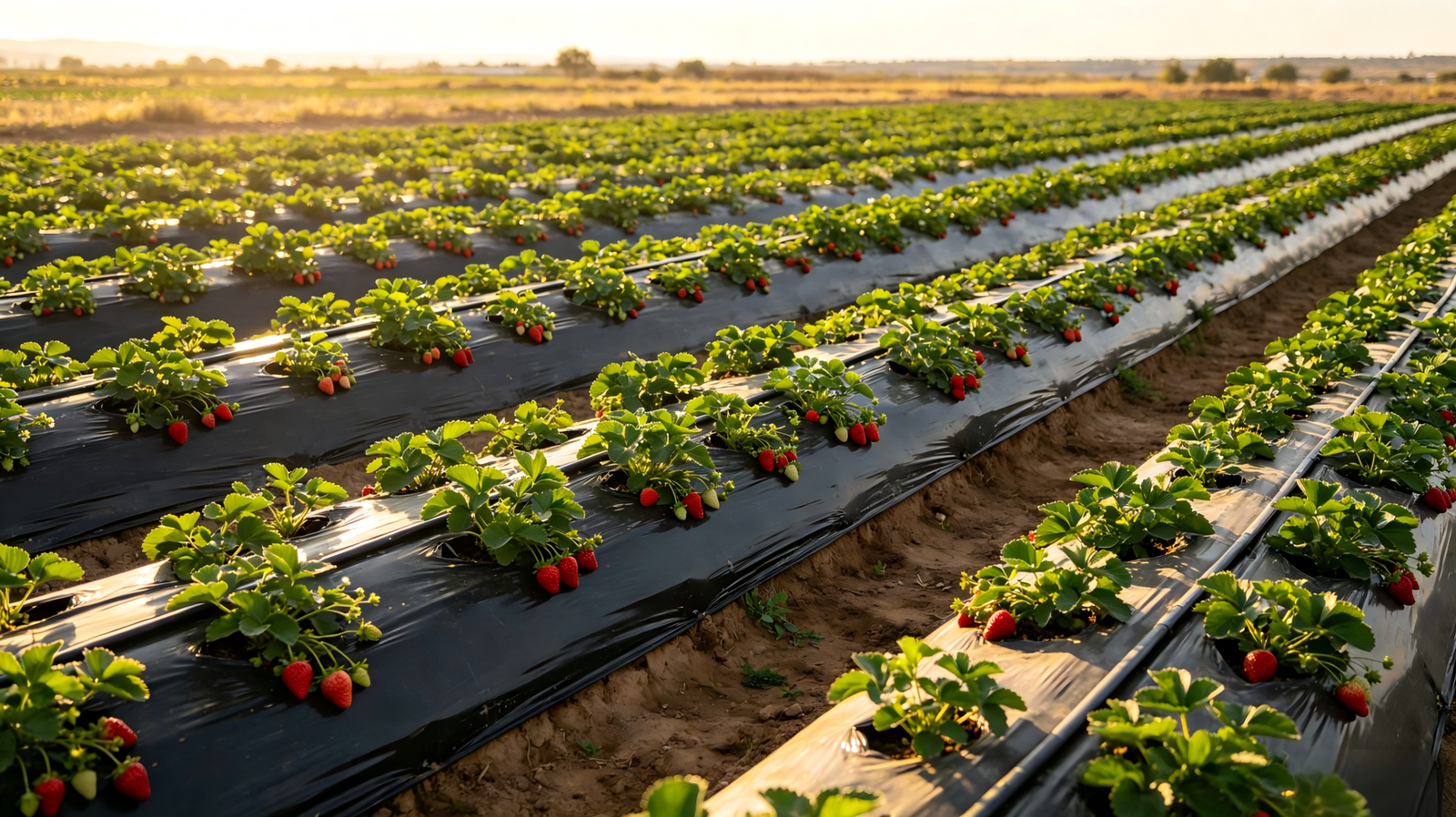
Drip Tape for Strawberries: Spacing, Flow Rate & Setup Guide 2026
Choosing the right drip tape for strawberries is more demanding than most crops — shallow roots, export grading requirements, and multi-season systems leave no room for the wrong specification. This guide covers everything procurement managers and farm operators need: emitter spacing, wall thickness, flow rate, and what to verify before placing an order.
Focus keyword: drip tape for strawberries · Updated: May 2026 · Reading time: ~8 min
▶ Quick Answer: Recommended Spec
The standard specification for drip tape for strawberries in commercial export production is: 16mm tube, 0.20mm wall thickness, 10–20cm emitter spacing, 1.0 L/h flow rate, 100% virgin LLDPE. Strawberry root systems are shallower than most crops — concentrated in the top 15–20cm of soil — which demands closer emitter spacing and lower flow rates than peppers or tomatoes. For multi-season raised-bed systems, the correct specification is not negotiable on wall thickness: 0.20mm minimum, virgin LLDPE confirmed by certificate.
Why Strawberries Need a Different Specification
Drip tape for strawberries requires a more precise specification than most field crops for two reasons that directly affect export-grade yield: root architecture and grading sensitivity.
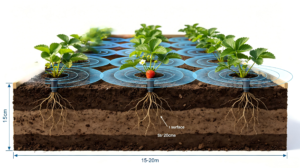
Strawberry root systems are shallow — the majority of active roots sit within 15–20cm of the soil surface, concentrated within 10–12cm of the crown. A dry zone of even 5cm between emitters causes moisture stress that translates directly into smaller, less uniform fruit. Unlike peppers or tomatoes where some variation is absorbed by deeper root systems, strawberries register every inconsistency in irrigation delivery as visible size variation at harvest.
The grading implication is significant. Export strawberries are graded by size category — fruit that falls below the minimum diameter for the contracted grade is either downgraded or rejected. Irrigation inconsistency is one of the primary causes of yield falling below contracted grade specifications, and it is entirely preventable with the correct tape specification and spacing.
Bottom line: This specification decision is not a cost optimization exercise — it is a yield quality protection decision. The cost difference between 0.18mm and 0.20mm tape, or between 20cm and 15cm spacing, is minor. The revenue impact of incorrect specification across a full season is not.
What Different Buyers Actually Care About
Choosing the right tape for this crop involves different priorities depending on the scale and role of the buyer.
🍓 Commercial Strawberry Farms (20–200 ha)
For commercial strawberry operations supplying export markets — including Mexico’s Baja California and Sonora regions, where strawberry export to North America is a major revenue source — the specification is set by the grading contract. Any tape failure or inconsistency that reduces export-grade yield percentage directly reduces season revenue. These farms need confirmed 0.20mm specification, consistent batch quality, and a supplier who can maintain supply through the planting season.
They need: Spec-verified 0.20mm, batch measurement certificates, and reliable delivery before their planting window closes.
🌍 Regional Distributors (Latin America)
Distributors supplying strawberry farms in Mexico, Colombia, and Chile carry the quality risk for their product recommendations. A field failure in a 50-hectare strawberry installation during peak season creates claims that exceed the margin on the entire order. The distributor’s interest is in sourcing a verified product that performs as specified — season after season, batch after batch.
They need: SGS certificate, batch consistency data, and a supplier who treats documentation as standard, not exceptional.
📋 Agronomy Consultants & Project Specifiers
Irrigation consultants and agronomists specifying systems for strawberry producers need technical data they can defend to farm owners and auditors. The specification — 0.20mm, flat emitter, 15cm spacing, 1.0 L/h — has to be justified on agronomic grounds, not just supplier preference. Reliable technical data from a verifiable supplier protects their recommendation.
They need: Emitter output data at operating pressure, system design support, and documentation for project records.
👨🌾 Small Strawberry Producers (1–15 ha)
Smaller operations frequently underspecify tape thickness to reduce upfront cost — then pay for it through reduced export-grade yield, or through early tape failure that forces mid-season replacement. A clear, direct recommendation matched to their crop is more valuable than a catalog of options. One right answer saves them from an expensive mistake.
They need: 0.20mm flat emitter, 15cm spacing — and a contact they can reach when installation questions come up.
Drip Tape for Strawberries: Emitter Spacing, Flow Rate & Wall Thickness
Emitter Spacing
Drip tape for strawberries requires closer emitter spacing than most other horticultural crops. The standard recommendation is 10–20cm, with 15cm being the most commonly used specification for commercial raised-bed production.
- 10cm spacing: High-density greenhouse systems, sandy soils with minimal lateral water movement, maximum uniformity requirement.
- 15cm spacing: Standard for commercial open-field and plastic-mulch raised-bed production. Covers most soil types and plant densities.
- 20cm spacing: Acceptable on loamy to clay soils with good lateral water movement, or where in-row plant spacing exceeds 30cm.
Flow Rate
The recommended flow rate for drip tape for strawberries is 1.0 L/h per emitter. This is lower than the typical pepper or tomato specification for an agronomic reason: strawberry crowns are highly susceptible to crown rot (Phytophthora cactorum) when surface moisture is elevated. A flow rate above 1.5 L/h on lighter soils can create surface saturation near the crown that promotes fungal development. Keeping flow at 1.0 L/h concentrates moisture in the root zone while keeping the crown base drier.
Wall Thickness
0.20mm is the minimum specification for drip tape for strawberries. Strawberry systems are installed as multi-season setups — typically 2–3 years — and the tape undergoes mechanical stress during installation on raised beds and UV exposure throughout the growing season. In major strawberry production regions including Mexico’s Pacific coast and the Jordan Valley, 0.20mm virgin LLDPE is the industry baseline, not a premium upgrade.
Why 0.18mm is not enough for strawberries: The combination of multi-season requirement, raised-bed installation stress, and UV exposure in key growing regions means 0.18mm tape typically shows performance degradation in its second season. The cost difference per hectare between 0.18mm and 0.20mm is marginal compared to the risk of reduced output uniformity in year two of a three-year installation.
Full Specification Table: Drip Tape for Strawberries
| Parameter | Open Field / Raised Bed | High-UV / Arid Region | Greenhouse |
|---|---|---|---|
| Tape type | Flat Emitter only | Flat Emitter only | Flat Emitter |
| Tube diameter | 16mm | 16mm | 16mm |
| Wall thickness | 0.20mm minimum | 0.20mm minimum | 0.15–0.18mm |
| Emitter spacing | 10–20cm (15cm standard) | 10–15cm | 10–15cm |
| Flow rate | 1.0 L/h | 1.0 L/h | 1.0 L/h |
| Raw material | 100% virgin LLDPE | 100% virgin LLDPE | 100% virgin LLDPE |
| Expected life | 2–3 seasons | 2 seasons | 3 seasons |
| Filtration | 120-mesh minimum | 120-mesh minimum | 120-mesh minimum |
Reference: FAO Irrigation and Drainage. Specifications on our drip irrigation tape product page.
Step-by-Step Installation on Raised Beds
The following installation sequence applies to commercial raised-bed strawberry production under plastic mulch — the dominant production system in Latin America.
1
Form raised beds and prepare sub-laterals
Build raised beds 25–30cm high, 80–100cm wide. For double-row systems (two strawberry rows per bed), the tape will run centered or offset depending on row positioning. Lay sub-lateral supply pipes along the bed before tape installation and flush them clear of debris.
2
Connect and position drip tape with emitters up
Connect tape to sub-laterals with 16mm barbed fittings. Lay tape along the bed with emitters facing upward (12 o’clock position). For single-row beds, run one tape centered on the bed. For double-row beds, run one tape under each plant row, or one centered tape if row spacing is ≤30cm and soil is loamy.
3
Flush and cap before mulching
Open end caps and run water through each tape run for 2–3 minutes to clear installation debris. Cap ends. This pre-flush is non-negotiable — debris trapped under mulch causes emitter blockages that are extremely difficult to locate and clear after the crop is planted.
4
Apply plastic mulch film
Cover beds with black or silver-black mulch film. Anchor film edges securely — raised bed profiles and wind exposure in open-field strawberry production can lift inadequately anchored film, exposing tape to UV damage and physical displacement. Silver-black film reduces soil temperature more effectively in warm climates.
5
Verify output before transplanting
Run the system at operating pressure and check for uniform drip output along the full run length before making planting holes. Any emitters that are not dripping must be addressed before transplanting — locating blocked emitters in an established strawberry crop under mulch is extremely time-consuming and involves crop disturbance.
For systems combining drip irrigation with nutrient delivery, a
smart fertigation system
delivers soluble fertilizers directly through the tape for precise, stage-specific feeding throughout the strawberry growing cycle.
How Many Meters of Drip Tape Per Hectare of Strawberries?
Drip tape for strawberries requires more meters per hectare than most other crops due to close row spacing. Use the formula below for accurate project planning.
📐 Calculation Formula
Total meters = (Field width ÷ Row spacing) × Field length × 1.10
1.10 = 10% buffer for connections, flushing ends, and field variation. All values in meters.
| Bed Configuration | Row Spacing | Field Length | Total / Hectare |
|---|---|---|---|
| Single row, close | 0.25 m | 100 m | ≈ 44,000 m |
| Single row, standard | 0.30 m | 100 m | ≈ 36,700 m |
| Double row on 1.0m bed | 0.30 m (per row) | 100 m | ≈ 36,700 m × 2 |
| Wide-row system | 0.40 m | 100 m | ≈ 27,500 m |
Based on 100m × 100m field. For large projects or irregular field layouts, contact us for a full quantity estimate →
Strawberries vs Peppers: Key Specification Differences
Both crops use flat emitter tape with 100% virgin LLDPE. The specification differences reflect their different root architectures and growing systems. If you are sourcing for both crops simultaneously, a 0.20mm flat emitter tape at 20cm spacing covers both — but strawberry-dedicated beds benefit from 15cm spacing.
| Parameter | 🍓 Strawberries | 🌶️ Peppers |
|---|---|---|
| Wall thickness | 0.20mm minimum | 0.18mm (0.20mm in high-UV) |
| Emitter spacing | 10–20cm (15cm standard) | 20–30cm |
| Flow rate | 1.0 L/h | 1.0–1.38 L/h |
| Tape per hectare | ~36,700 m (0.30m rows) | ~22,000 m (0.50m rows) |
| System life | 2–3 seasons | 1–2 seasons |
| Primary disease risk from wrong spec | Crown rot (surface moisture) | Blossom drop, uneven sizing |
For complete pepper-specific guidance, see our
drip tape for peppers guide.
For the full comparison of flat emitter vs labyrinth tape types, see our
flat emitter vs labyrinth guide.
Sourcing drip tape for strawberries for your farm or project?
We supply verified drip tape for strawberries at 0.20mm with 100% virgin LLDPE — SGS raw material certificate included with every order. Whether you need tape for a large export operation or a first-season setup, our team can confirm the right specification and prepare a quantity estimate for your field layout.
Frequently Asked Questions
Strawberry Irrigation
Drip Irrigation
Precision Irrigation
Latin America Farming
Horticulture
Smart Farming