Virgin LLDPE Drip Tape vs Recycled: Why Material Matters for Farm ROI
What separates a reliable drip tape supplier virgin LLDPE from one selling blended material at the same claimed specification — and how to verify what you actually receive before it affects your crop.
Focus keyword: drip tape supplier virgin LLDPE · Updated: May 2026 · Reading time: ~8 min
▶ Quick Answer
When sourcing from a drip tape supplier virgin LLDPE, the material specification determines everything downstream: UV lifespan, wall thickness consistency, and whether the tape performs for one season or three. The performance gap between virgin and blended material is real, measurable, and invisible to the naked eye — which is precisely why verification matters. For any export-grade vegetable crop or multi-season installation, 100% virgin LLDPE is not a premium option. It is the baseline specification.
What Virgin LLDPE and Recycled Material Actually Mean
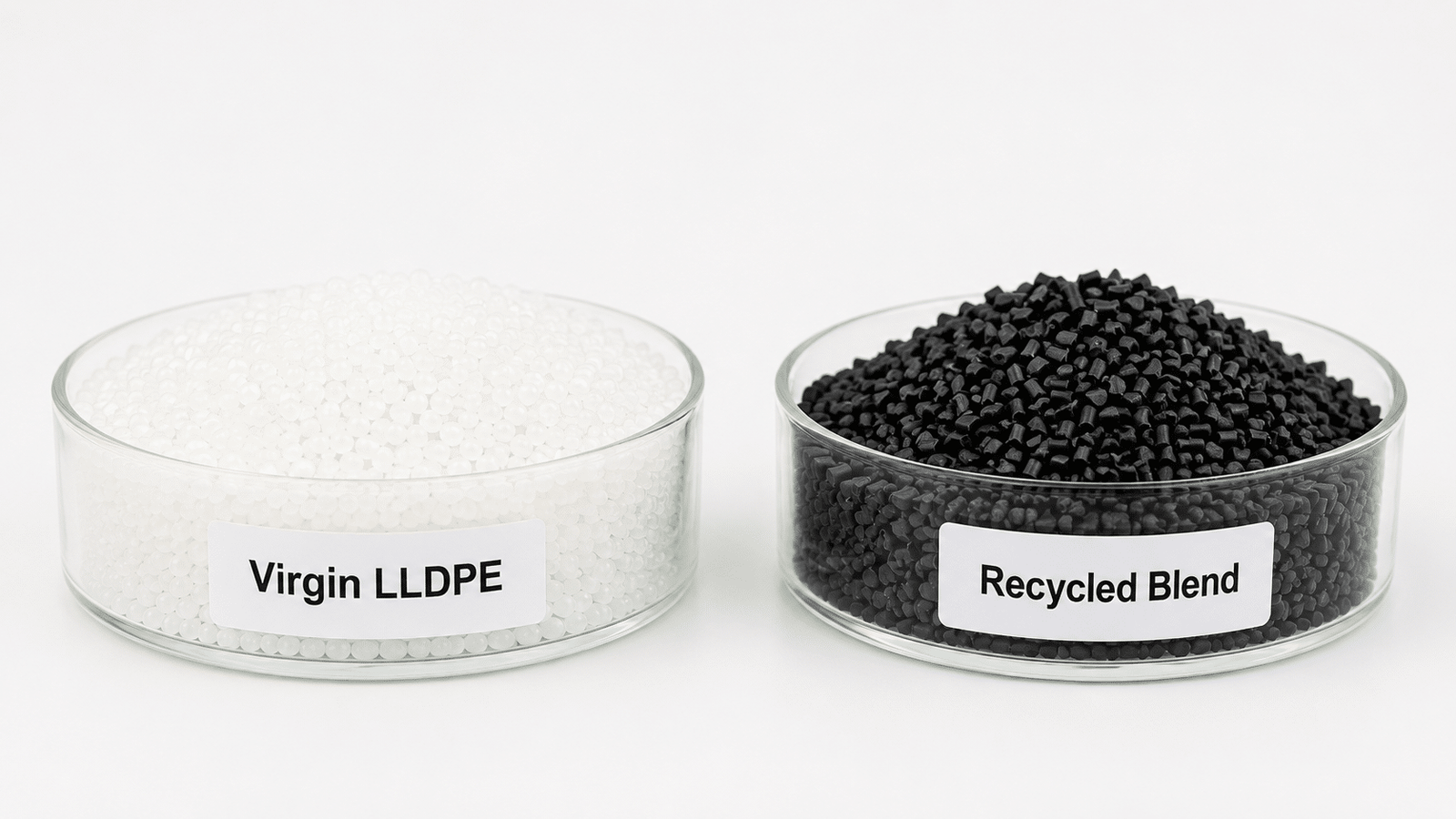
LLDPE — Linear Low-Density Polyethylene — is the base polymer used to manufacture drip irrigation tape. The critical variable is whether the resin used in production is virgin (new, unprocessed resin from a primary producer) or blended (a mixture of virgin resin and reprocessed plastic from various industrial or post-consumer sources).
In practice, the term “virgin LLDPE” is frequently used in product descriptions without verification. A drip tape supplier virgin LLDPE claim is only meaningful when accompanied by a third-party raw material test certificate — because no visual inspection can distinguish virgin from blended material in a finished tape roll.
100% Virgin LLDPE
- Consistent molecular weight and density
- Tensile strength: above 20 MPa
- UV stabilizer distributed evenly throughout
- Wall thickness variance: ±0.01mm
- Rated UV lifespan: 3–5 years
- Verifiable by SGS / Bureau Veritas certificate
Blended / Recycled Material
- Variable molecular weight — batch dependent
- Tensile strength: typically 12–16 MPa
- UV stabilizer uneven — hot spots of weakness
- Wall thickness variance: ±0.03–0.05mm
- Field lifespan: 1–2 seasons in most conditions
- Often sold without documentation
The invisible risk: A tape roll labeled “0.18mm virgin LLDPE” from an unverified supplier may measure 0.18mm at the point tested — but contain blended material with a ±0.04mm variance across the roll. The tape will fail before the end of the first high-UV season, and the problem will not be traceable without a material certificate.
What Different Buyers Actually Care About
The raw material question affects every buyer type differently — but the underlying issue is the same for all of them: the risk is hidden until the tape is already installed.
🌍 International Distributors
A distributor who recommends a supplier that later delivers blended-material tape owns the resulting field failures with their customers. The raw material certificate is not a paperwork exercise — it is liability protection. Distributors switching to a new drip tape supplier should require a material certificate before approving the first shipment, not after the second complaint.
They need: SGS or BV certificate per production lot, and a supplier who understands that consistent documentation is part of the product — not an optional extra.
🏭 Commercial Farm Operators
For farms running peppers or tomatoes at 50–200 ha, a tape failure mid-season in an installed, mulched system is not just a cost — it is an operational crisis. The ROI calculation strongly favors paying the modest premium for verified virgin LLDPE over the risk of mid-season replacement or reduced export-grade yield from uneven emitter output.
They need: A supplier who can demonstrate batch consistency across multiple orders — not just the sample roll.
📋 EPC & Government Projects
Irrigation infrastructure projects in the Middle East and Latin America typically specify raw material in tender documents. EPC contractors who submit product that does not meet the virgin LLDPE specification — even if the tape looks identical — face contract penalties and potential project disqualification. The certificate is contractual evidence, not optional documentation.
They need: Full traceability — certificate linked to the specific production lot in the delivered shipment.
👨🌾 Independent Farm Owners
The buyer most likely to be misled by a “virgin LLDPE” label without a certificate. A straightforward explanation of the per-season cost difference — and of how to ask one simple question (“Can you provide an SGS certificate?”) — gives this buyer enough information to make the right supplier decision without needing to understand polymer chemistry.
They need: One clear question to ask any supplier: “Can you provide an SGS raw material test report?” A supplier who cannot answer yes is the wrong supplier.
The ROI Calculation: Per-Meter vs Per-Season Cost
The per-meter cost difference between a verified drip tape supplier virgin LLDPE product and a blended-material alternative is typically 15–25%. The per-season cost comparison often tells a different story.
📊 Example: Pepper Farm, 1 Hectare, 22,000m Drip Tape
| Scenario | Tape Type | Seasons | 3-Season Total Cost |
|---|---|---|---|
| A — Recycled blend | 0.18mm blended | 1 per roll | 3× tape cost + 3× installation |
| B — Virgin LLDPE | 0.18mm virgin | 2 per roll | 1.5× tape cost + 1.5× installation |
| C — Virgin LLDPE | 0.20mm virgin | 3 per roll | 1× tape cost + 1× installation |
Installation cost (labor, fitting, mulch coordination) is typically 40–60% of the total tape replacement cost — making Scenarios B and C significantly more economical over a 3-season horizon even before accounting for yield quality differences.
The yield factor: This calculation does not account for the yield quality impact. Blended-material tape with higher wall thickness variance produces less consistent emitter output — which in a pepper or tomato crop translates to a measurable reduction in export-grade fruit percentage. When the value of lost Grade A yield is included, the ROI difference between virgin and recycled material tape widens considerably.
Performance Comparison: Virgin LLDPE vs Recycled Material
| Performance Factor | 100% Virgin LLDPE | Blended / Recycled |
|---|---|---|
| Tensile strength | >20 MPa — consistent | 12–16 MPa — variable |
| UV degradation rate | Slow — rated 3–5 years | Fast — 1–2 seasons typical |
| Wall thickness variance | ±0.01mm | ±0.03–0.05mm |
| Emitter output uniformity | Consistent (Cv <0.05) | Degrades over season |
| Cold weather brittleness | Low — maintains flexibility | Higher — cracks at connection points |
| Verifiable by certificate | Yes — SGS / BV test report | Rarely documented |
| Recommended for export crops | Yes | Not recommended |
Reference: FAO Irrigation and Drainage. For product documentation, contact our team.
How to Identify a Genuine Virgin LLDPE Drip Tape Supplier
Finding a genuine drip tape supplier virgin LLDPE is not difficult — but it requires asking the right questions and knowing what acceptable evidence looks like.
- Ask for the raw material certificate before sampling. A legitimate virgin LLDPE supplier will have this documentation on file and will send it promptly. A supplier who says “we can get it” or “we need to arrange that” for an existing product line is a warning sign — the certificate should already exist.
- Check that the certificate references the specific raw material grade. The certificate should identify the LLDPE resin grade by supplier and specification. Generic “polyethylene” without a named resin grade is insufficient documentation for a virgin material claim.
- Request roll weight data alongside wall thickness data. Virgin LLDPE extrudes with more consistent density than blended material. A roll of 2,000m of 16mm / 0.18mm virgin tape should weigh within 2–3% of its specified weight. Higher variance suggests either shorter actual length or inconsistent material.
- Compare multiple production batches, not just the sample roll. Some suppliers use virgin material for sample rolls and switch to blended material for bulk production. Requesting batch data from 2–3 different production runs reveals whether the specification is consistent across production.
- Check whether the supplier is willing to accept pre-shipment inspection. A genuine virgin LLDPE supplier has nothing to hide from a third-party inspection. Reluctance to allow pre-shipment inspection of bulk orders is a significant indicator of material substitution risk.
5 Red Flags That Signal Recycled or Blended Material
1
No material certificate available, or certificate takes more than 3 days to produce.
A supplier who routinely produces this product should have current batch certificates on file. Delays suggest the certificate either does not exist or needs to be fabricated.
2
Wall thickness variance above ±0.015mm across a single roll sample.
High variance is the most reliable field indicator of blended material. Virgin LLDPE extrudes with consistent viscosity — blended material does not.
3
Price is significantly below market range for verified virgin material.
Virgin LLDPE has a real cost floor based on resin prices. If a price seems too low to be consistent with genuine virgin material, it likely is not genuine virgin material.
4
Roll weight varies more than 5% between batches of the same specification.
Consistent roll weight is a proxy for consistent material density and tape length. Batch-to-batch weight variance above 5% suggests material substitution between production runs.
5
Supplier refuses or delays pre-shipment inspection for bulk orders.
Pre-shipment inspection is standard practice for large irrigation supply orders. A supplier with nothing to hide welcomes it. Resistance to inspection is the clearest possible signal of something to hide.
For a broader set of sourcing verification steps, see our drip tape sourcing checklist and the wall thickness verification guide.
Impact by Crop Type
The consequence of using blended-material tape varies by crop — the higher the crop value and the longer the season requirement, the greater the financial impact of a material quality failure.
| Crop | Risk of Using Blended Material | Recommended Spec |
|---|---|---|
| 🌶️ Peppers | High — uneven output reduces export-grade fruit %, early failure under UV | 100% virgin LLDPE, 0.18mm+ |
| 🍓 Strawberries | Very high — shallow roots amplify irrigation inconsistency, multi-season requirement | 100% virgin LLDPE, 0.20mm |
| 🍅 Tomatoes | High — grading impact from uneven irrigation, same as peppers | 100% virgin LLDPE, 0.18mm+ |
| 🌽 Corn / Sugarcane | Low to moderate — single season, cost drives decision | Virgin LLDPE recommended; blended acceptable for single season on flat terrain |
| 🍇 Orchards | Very high — multi-year system, failure cost amplified by installation complexity | 100% virgin LLDPE, 0.20–0.25mm |
For crop-specific emitter spacing and flow rate guidance, see our drip tape for peppers guide. Full product specifications on our drip irrigation tape product page.
Looking for a verified virgin LLDPE drip tape supplier?
We provide SGS raw material certificates with every order, wall thickness measurement data per production lot, and consistent documentation across all shipments. Request a sample and certificate to verify before committing to volume.
Frequently Asked Questions
Drip Tape Quality
Drip Tape Supplier
Drip Irrigation
Precision Irrigation
Farm ROI
Smart Farming