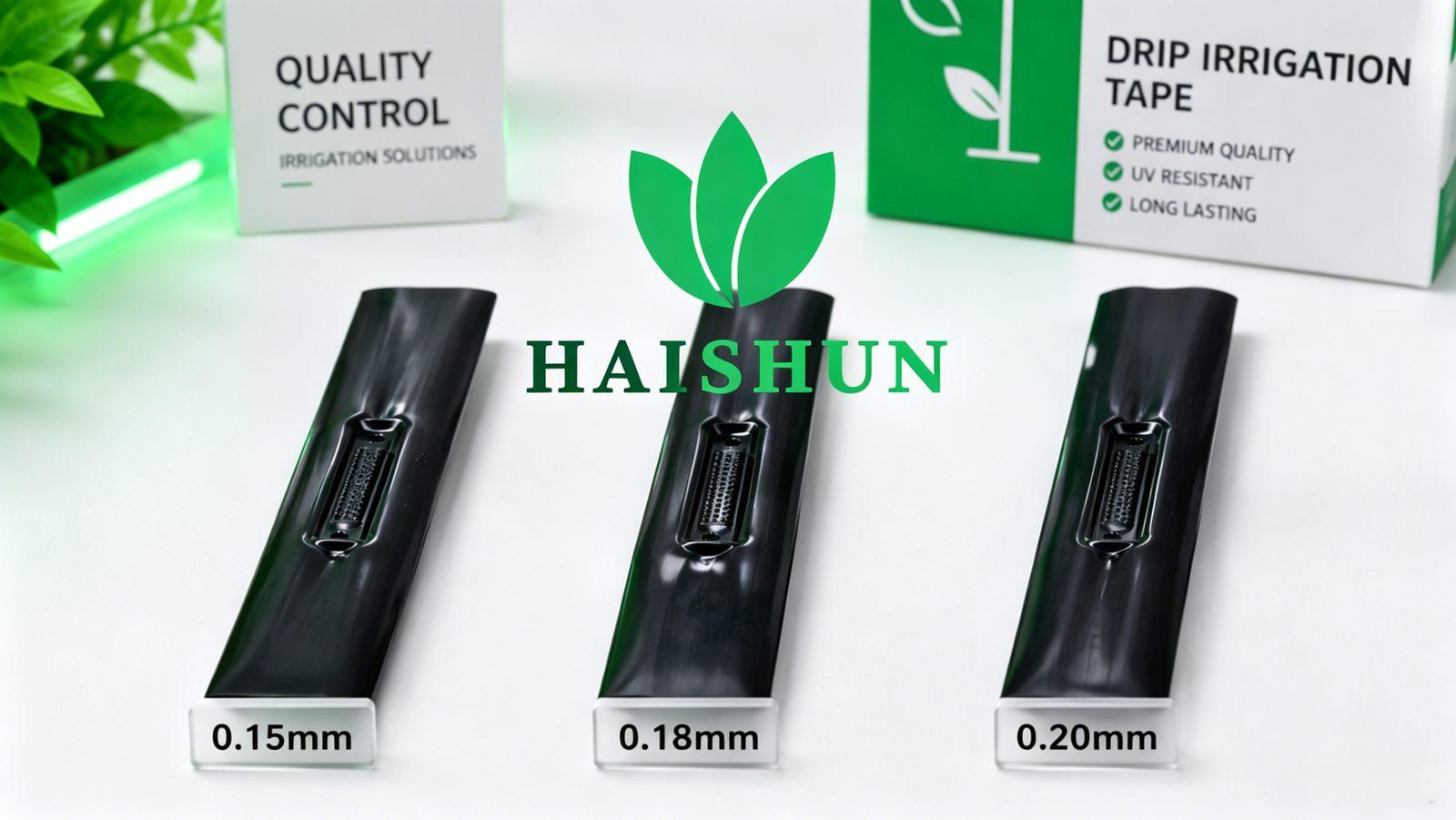
How to Choose Drip Tape Wall Thickness: 0.15mm vs 0.18mm vs 0.20mm
A practical buyer’s guide to drip tape wall thickness — what each specification means for lifespan, UV resistance, and crop fit, and how to verify you receive what you ordered.
Focus keyword: drip tape wall thickness · Updated: May 2026 · Reading time: ~7 min
▶ Quick Answer
Drip tape wall thickness determines how long the tape performs in the field. 0.15mm is a single-season product for budget row crops. 0.18mm is the most widely exported specification — the practical default for peppers, tomatoes, and most vegetables for 1–2 seasons. 0.20mm is required for high-UV regions, strawberries, orchards, or any 2–3 season installation. For all multi-season applications, wall thickness must be paired with 100% virgin LLDPE raw material — thickness alone without material verification is not a reliable quality indicator.
Why Drip Tape Wall Thickness Is the Most Important Specification
Of all the specifications on a drip tape data sheet, drip tape wall thickness has the greatest impact on actual field performance. It governs three outcomes that directly affect the return on every meter installed:
- UV lifespan: Thicker walls contain more UV stabilizer and degrade more slowly under direct sun. In high-UV environments, the gap between 0.15mm and 0.20mm can represent two additional seasons of service life.
- Puncture and abrasion resistance: During installation and retrieval in rocky or coarse soil, thicker tape withstands the mechanical stress that splits thinner material at fold points and fitting connections.
- Pressure consistency over time: As tape ages, micro-leaks from wall degradation reduce end-of-run pressure uniformity. Thicker tape maintains wall integrity for longer, keeping delivery consistency stable across seasons.
The cost logic: A 0.15mm tape that fails partway through a two-season crop is not cheaper than a 0.18mm tape that completes both seasons. Per-season cost — not per-meter cost — is the correct metric for wall thickness decisions.
What Different Buyers Actually Care About
The drip tape wall thickness decision involves different risks depending on the buyer’s role in the supply chain.
🌍 International Distributors
A single underspecified batch that fails in a customer’s field creates warranty claims and damages the distributor’s account permanently. Distributors need consistency across batches — the 0.18mm product in March must measure 0.18mm in September.
They need: Batch-to-batch measurement data and a supplier who flags any raw material substitution before shipment — not after.
🏭 Large Farm Operators
For 50–200 ha vegetable operations, the specification decision made at procurement is the one the farm lives with for the growing season. Replacing tape mid-season under mulch with an established crop is not operationally feasible.
They need: A clear thickness recommendation for their crop and climate, and a sample-verified product before committing to full-season volume.
📋 EPC Contractors & Project Buyers
Government and institutional projects specify wall thickness in tender documents. EPC procurement needs delivered product to match exactly — not “approximately 0.18mm.” Measurement data and certification documentation are contractual requirements.
They need: ISO 9261 certification, wall thickness measurement certificates per production lot, and consistent documentation across all project shipments.
👨🌾 Independent Farm Owners
Most likely to underspecify to save upfront cost. A clear explanation of per-season cost — not per-meter cost — is the most useful guidance for this buyer type. One right answer is more valuable than three options to choose between.
They need: A direct recommendation matched to their crop and region, with a contact they can reach to confirm before ordering.
0.15mm vs 0.18mm vs 0.20mm: Full Breakdown
0.15mm
6 mil · 1 Season
Budget spec for single-season row crops on flat terrain. Adequate for corn, sugarcane, cotton where cost-per-hectare is the primary driver.
✅ Right for:
- Single-season only
- Flat terrain, filtered water
- Cost-per-hectare priority
⚠️ Not for:
- Export crops, high-UV
- Multi-season plans
Most Exported
0.18mm
7 mil · 1–2 Seasons
The de facto export standard. Best cost-to-durability balance for most B2B buyers. Covers peppers, tomatoes, cucumbers, and most vegetables for 1–2 growing seasons.
✅ Right for:
- Peppers, tomatoes, vegetables
- 1–2 season installations
- Most export markets
⚠️ Upgrade if:
- High-UV / arid region
- 3+ season plan
0.20mm
8 mil · 2–3 Seasons
For demanding conditions — high UV, multi-year systems, or crops where consistency across seasons directly determines export revenue.
✅ Right for:
- Strawberries, orchards
- Northern Mexico, Jordan Valley, Saudi Arabia
- 2–3 season systems
⚠️ Overkill for:
- Single-season row crops
- Covered greenhouse systems
What about 0.25mm–0.40mm? These specifications exist for permanent orchard systems and multi-year greenhouse installations where the tape is expected to last 3–5 seasons. These are project-specific — contact our team if your installation timeline extends beyond 3 seasons.
Drip Tape Wall Thickness: Specification Comparison
| Specification | 0.15mm | 0.18mm | 0.20mm |
|---|---|---|---|
| Expected seasons | 1 | 1–2 | 2–3 |
| UV resistance | ★★☆☆☆ | ★★★★☆ | ★★★★★ |
| Puncture resistance | Low | Good | High |
| Acceptable variance | ±0.01mm | ±0.01mm | ±0.01mm |
| Raw material required | Virgin LLDPE recommended | 100% virgin LLDPE | 100% virgin LLDPE |
| Best application | Corn, sugarcane, cotton | Peppers, tomatoes, vegetables | Strawberries, orchards, arid |
| Certification | ISO 9261 | ISO 9261 · SASO · ASTM | ISO 9261 · SASO · ASTM |
Reference: FAO Irrigation and Drainage. For specifications, contact our team.
Wall Thickness and Raw Material: Why Both Matter
Specifying drip tape wall thickness without specifying raw material is incomplete. A 0.20mm tape made from blended recycled material will underperform a 0.18mm tape made from 100% virgin LLDPE in every durability metric that matters in the field.
| Property | 100% Virgin LLDPE | Blended / Recycled |
|---|---|---|
| Tensile strength | Above 20 MPa — consistent | Varies — often 12–16 MPa |
| UV degradation | Slow — 3–5 year rated life | Fast — degrades within 1–2 seasons |
| Thickness variance | ±0.01mm (quality production) | ±0.03–0.05mm (common) |
| Visual identification | Not possible — requires test report | Not possible — requires test report |
For more on raw material verification and supplier qualification, see the sourcing checklist in our flat emitter vs labyrinth drip tape guide.
How to Verify Wall Thickness Before Accepting a Shipment
Wall thickness verification is the most actionable quality check available without laboratory access. Here is the protocol experienced procurement managers use.
- Request pre-shipment measurement data. Minimum 5 caliper readings per 100m roll sample, taken at the tape’s thinnest cross-section. This data should accompany the shipping documents.
- Verify against variance tolerance. Quality-grade tape shows ±0.01mm variance. Above ±0.015mm indicates inconsistent extrusion or non-virgin material — request clarification before accepting.
- Weigh a sample roll on arrival. Consistent roll weight within 2–3% of specification confirms stable material density between production batches. A lighter-than-specified roll means shorter length or thinner wall.
- Request the raw material certificate. SGS or Bureau Veritas test report confirming 100% virgin LLDPE. This is the only way to distinguish virgin from blended material — visual inspection cannot.
- Test a sample length at operating pressure. For first-time orders or new batches, run a 50m sample under field pressure before accepting bulk delivery. Leaks in the first irrigation cycle indicate defects that would compromise the full installation.
View our drip irrigation tape product page for specifications, or contact us to request a sample and measurement certificate.
Wall Thickness Recommendation by Crop and Climate
| Crop | Standard Climate | High-UV / Arid | Greenhouse |
|---|---|---|---|
| 🌶️ Peppers | 0.18mm | 0.20mm | 0.15–0.18mm |
| 🍅 Tomatoes | 0.18mm | 0.20mm | 0.15–0.18mm |
| 🍓 Strawberries | 0.18–0.20mm | 0.20mm | 0.15–0.18mm |
| 🌽 Corn | 0.15mm | 0.18mm | N/A |
| 🌿 Sugarcane | 0.15mm | 0.18mm | N/A |
| 🍇 Orchards | 0.20mm | 0.20–0.25mm | 0.18–0.20mm |
| 🥬 Leafy Veg | 0.15–0.18mm | 0.18mm | 0.15mm |
“High-UV / Arid” includes: northern Mexico, Jordan Valley, Saudi Arabia agricultural regions. “Standard” covers most of Latin America, Southeast Asia, and Mediterranean climates.
For detailed crop-specific guidance on emitter spacing and flow rate, see our drip tape for peppers guide. Full specifications on our drip irrigation tape product page.
Need a wall thickness recommendation for your project?
Whether you are sourcing for a pepper farm in Latin America, an arid-region project in the Middle East, or a multi-year orchard system — we can confirm the right specification and provide measurement certificates with your sample order.
Frequently Asked Questions
Drip Tape
Drip Irrigation
Precision Irrigation
Smart Farming
Water Saving
Irrigation Sourcing