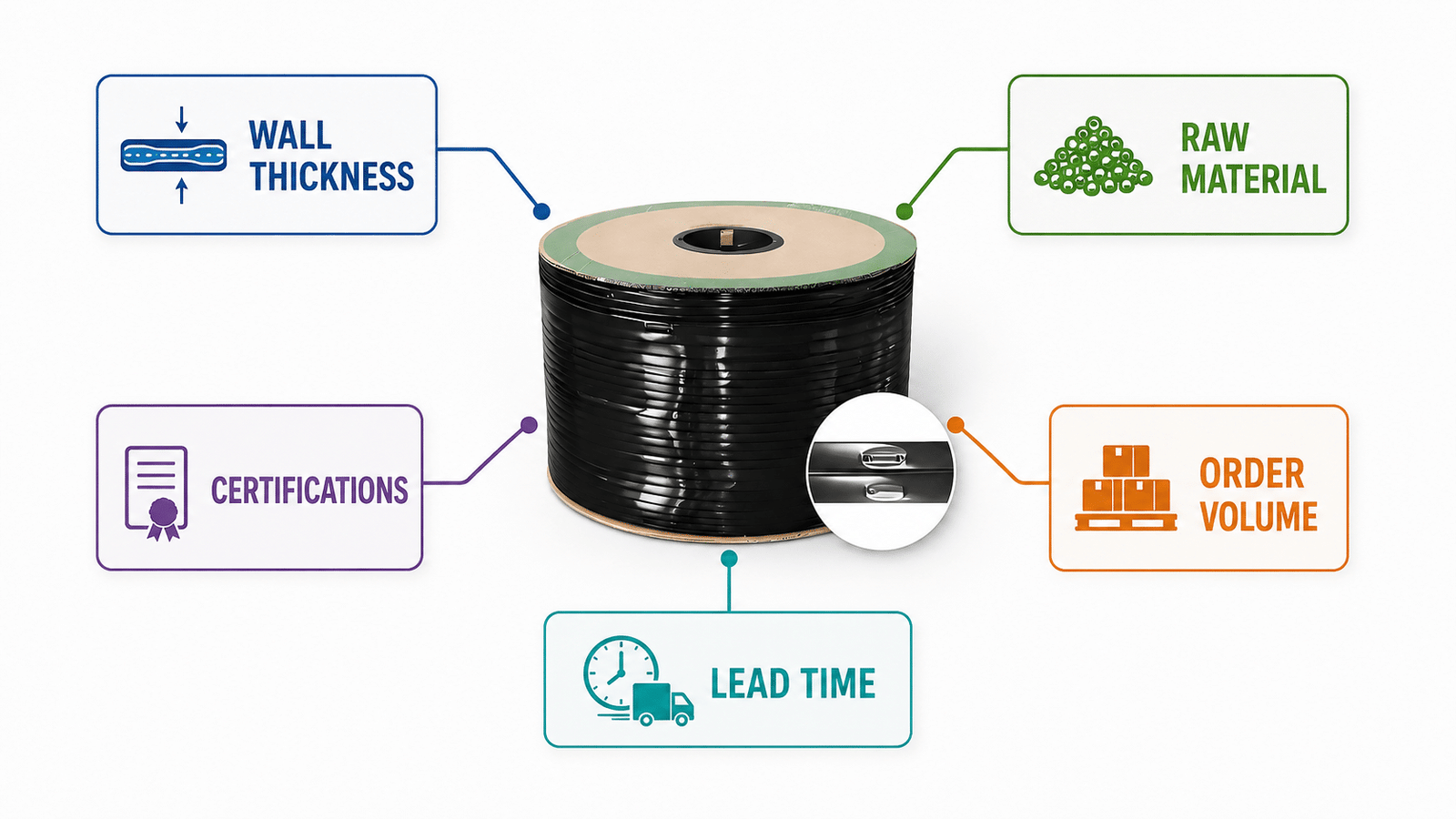
Drip Tape Price Per Meter: 5 Factors That Determine What You Pay
The drip tape price per meter for the same nominal specification can vary by 30–50% between suppliers. This guide explains the five factors behind every quote difference — so you can compare accurately and avoid paying more than you should, or less than is safe.
Focus keyword: drip tape price per meter · Updated: June 2026 · Reading time: ~7 min
▶ Quick Answer
Drip tape price per meter is not a fixed number — it is the output of five variables: wall thickness, raw material quality, certifications, order volume, and lead time. Two suppliers quoting “0.18mm flat emitter drip tape” can differ by 30–50% if those variables differ. Understanding what drives the drip tape price per meter is the only way to compare quotes on equal terms — and to recognize when a low price is a quality risk rather than a genuine saving.
What Different Buyers Actually Care About
When comparing the price per meter, what constitutes “value” differs significantly by buyer type.
🌍 International Distributors
Distributors sourcing for resale need a price that works across their customer base while maintaining margin. The risk is buying at the lowest drip tape price per meter and receiving blended material — one field failure in a customer’s 50ha installation erases the margin on the entire order and damages the account permanently.
They need: A verified price that reflects actual specification — not the lowest number attached to an unverified claim.
🏭 Large Farm Operators
For farms running 50–200 ha of vegetables, the the price per meter is one line in a much larger cost model. A 20% saving on tape that fails mid-season, requiring replacement under mulch, costs far more in labor and crop disruption than the saving was worth. Per-season cost, not per-meter cost, is the correct metric.
They need: Price that is consistent across repeat orders — batch substitution after the first order is a common risk.
📋 EPC & Project Procurement
Project procurement needs a price that holds through delivery and survives a client audit. Certifications, documentation, and lot traceability are part of the cost — a lower drip tape price per meter without these is not a comparable quote for tender purposes.
They need: Price inclusive of full documentation — raw material certificate, ISO 9261, market-specific certifications.
👨🌾 Independent Farm Owners
Smaller buyers are most vulnerable to choosing on the price per meter alone — buying 0.15mm blended material for strawberries because it was cheapest, then losing export-grade yield in season two. A clear explanation of what drives price differences protects this buyer from a decision they cannot easily reverse once the tape is installed.
They need: Understanding of which specification is right for their crop first — then a price for that specification.
5 Factors That Determine Drip Tape Price Per Meter
Factor 1
Wall Thickness
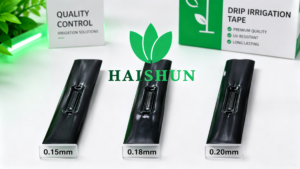
Wall thickness is the most direct cost driver in drip tape price per meter. More material per meter means higher raw material cost per meter — the relationship is nearly linear. Moving from 0.15mm to 0.18mm adds approximately 20% to the material weight; moving to 0.20mm adds a further 11%. The price difference between 0.15mm and 0.20mm tape of otherwise identical specification is typically 25–40%.
Factor 2
Raw Material: Virgin LLDPE vs Blended
Raw material quality is the factor most frequently obscured in the price per meter comparisons. Virgin LLDPE resin costs more than blended or recycled material — typically 15–25% more at the raw material level, which flows through to the finished tape price. A supplier offering a significantly lower price for “virgin LLDPE” tape without a third-party material certificate is almost certainly using blended material. The price difference is real; the specification claim may not be.
→ See: Virgin LLDPE vs Recycled: Why Material Matters for Farm ROI
Factor 3
Certifications
Certifications — ISO 9261, SASO for Saudi Arabia, ASTM D451 for North America — are not free. Factory audits, annual maintenance fees, and the quality systems required to hold certifications all add to manufacturing overhead, which is reflected in the the price per meter. A certified product from a factory that holds its own certifications costs more than an uncertified product or one using a shared certificate. For project and tender supply, this cost is unavoidable.
→ See: Sourcing Drip Tape from China: QC Checklist & 8 Red Flags
Factor 4
Order Volume
Volume is the most controllable factor in drip tape price per meter for buyers. Moving from a 10,000m sample order to a full 40HQ container (typically 1.8–2.6 million meters) reduces the per-meter price by 20–35% due to production run efficiency and material purchasing at scale. If your project does not reach container-load volume, working with a regional distributor who consolidates orders may provide access to volume pricing that direct small-volume sourcing cannot.
Factor 5
Lead Time
Rush orders carry a premium. Standard production lead time from established Chinese manufacturers is 15–25 days. Orders requiring delivery in under 10 days — common when planting schedules are missed or tape fails unexpectedly — typically carry a 10–20% surcharge on the price per meter. Planning procurement 45–60 days ahead of installation (accounting for production, inspection, and sea freight) eliminates this cost entirely.
How the 5 Factors Stack Up
| Factor | Cost Impact | Buyer Action |
|---|---|---|
| Wall thickness | +20–40% (0.15→0.20mm) | Specify correct thickness for crop — don’t underspec to save |
| Raw material | +15–25% (virgin vs blended) | Require SGS certificate — price without cert is unverifiable |
| Certifications | +5–15% (ISO / SASO / ASTM) | Confirm factory holds cert directly — not shared |
| Order volume | −20–35% (sample→container) | Consolidate orders or work with distributor for volume pricing |
| Lead time | +10–20% (rush orders) | Order 45–60 days ahead of installation to avoid surcharges |
How to Compare Quotes Properly
Comparing the price per meter accurately requires that quotes are for identical specifications. Most quote comparisons fail at this step.
Before treating two quotes as comparable, confirm each supplier has quoted:
- The same wall thickness — nominal and with documented variance tolerance
- The same raw material — virgin LLDPE with SGS/BV certificate, or stated as blended
- The same certifications — factory-held, not shared or borrowed
- The same roll length — actual meters per roll, not labeled specification
- The same delivery terms — FOB, CIF, or DDP affects landed cost significantly
The rule: A lower the price per meter is only a saving if the specification is genuinely identical. A 20% lower price from a supplier using blended material versus virgin LLDPE is not a saving — it is a risk transfer onto the buyer.
What to Include in a Quote Request
A complete quote request gets a comparable, accurate the price per meter. An incomplete request generates a quote you cannot use for comparison. Include the following:
📋 Quote Request Template
- Tube diameter: 16mm (standard) / 20mm (heavy-duty)
- Wall thickness: 0.15 / 0.18 / 0.20mm
- Emitter type: flat emitter / labyrinth
- Emitter spacing: 10 / 15 / 20 / 30cm
- Flow rate: 1.0 / 1.38 / 2.0 L/h
- Roll length: 2,000m (standard) / 3,000m
- Total quantity: X meters
- Raw material: 100% virgin LLDPE with SGS/BV certificate required
- Certifications required: ISO 9261 / SASO / ASTM D451 (specify market)
- Delivery port: [your port]
- Required delivery date: [date]
For the full specification selection guide, see
flat emitter vs labyrinth drip tape.
View available specifications on our
drip irrigation tape product page.
Ready to request a verified drip tape price per meter?
Use the template above and send it to us. We will confirm the specification, provide a the price per meter with full documentation, and respond within one business day.
Frequently Asked Questions
Drip Tape Sourcing
Drip Tape Cost
Drip Irrigation
Irrigation Sourcing
AgSupplyChain
Smart Farming