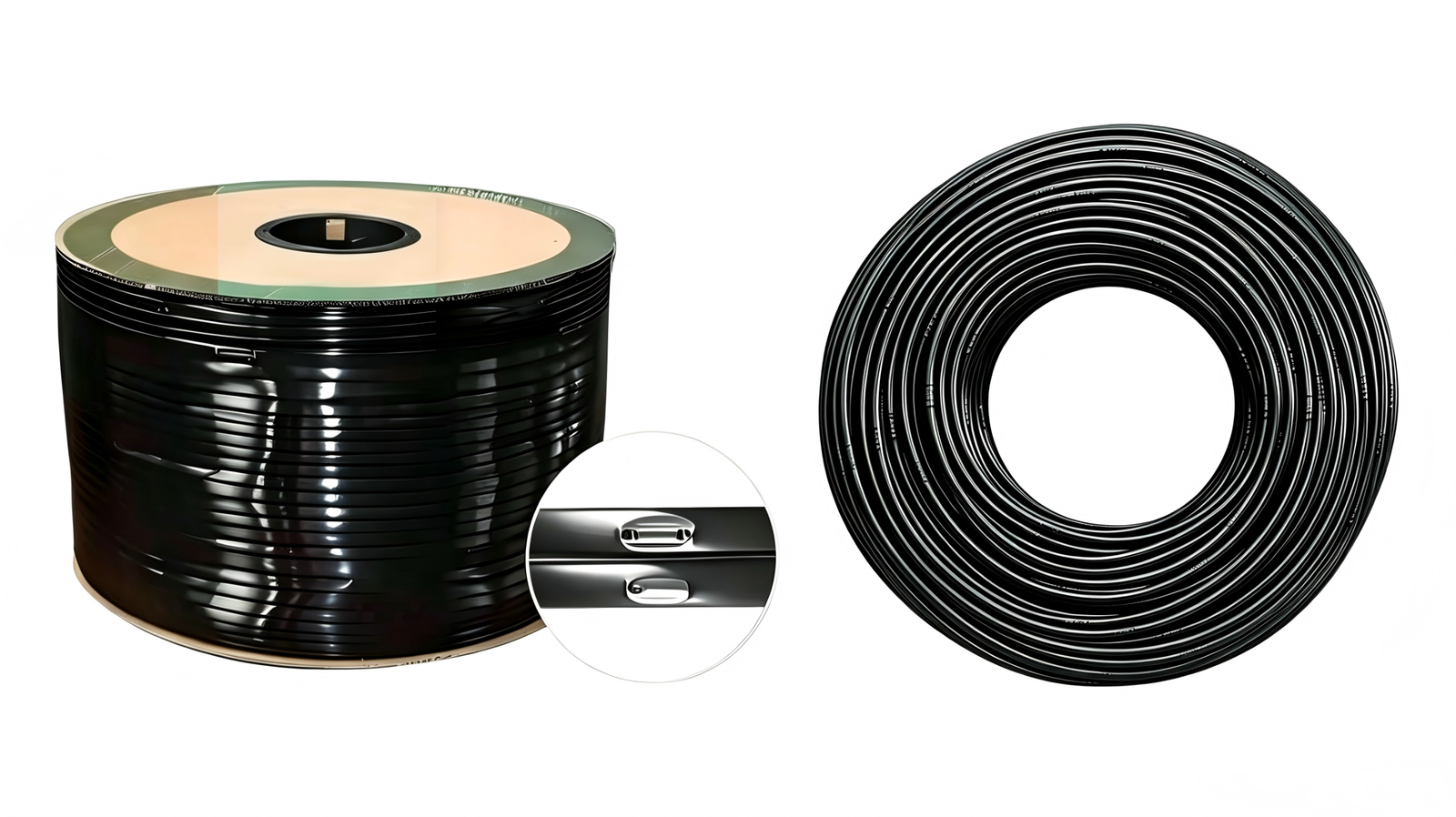
Drip Tape vs Drip Line: Which Is Right for Your Farm? 2026
Drip tape vs drip line is one of the first decisions in any drip irrigation project — and one where the wrong choice adds unnecessary cost or fails to deliver the lifespan the project requires. This guide explains the differences across five key dimensions and gives a clear recommendation by crop type.
Focus keyword: drip tape vs drip line · Updated: June 2026 · Reading time: ~7 min
▶ Quick Answer: 30-Second Decision
In the drip tape vs drip line decision, crop type and installation lifespan are the two determining factors:
- Annual vegetables (peppers, tomatoes, strawberries, corn): Use drip tape. Lower cost per meter, replaceable seasonally, adequate lifespan for 1–3 growing seasons.
- Permanent crops (orchards, vineyards, multi-year berry systems): Use drip line. Higher upfront cost, 10–15 year service life, pressure-compensating emitters for uneven terrain.
- Mixed operations: Drip tape on annual beds, drip line on permanent tree rows — each in its correct application.
What Each Product Actually Is
💧 Drip Tape
A thin, flat polyethylene tube that expands under pressure. Emitters are integrated into the tube wall at fixed spacing during manufacturing. The tube collapses flat when empty, making it compact for storage and shipping.
- Wall thickness: 0.15–0.25mm
- Tube diameter: 16mm (standard export)
- Emitter type: flat emitter or labyrinth
- Roll length: 2,000–3,000m
- Service life: 1–3 seasons
- Application: annual row crops
💧 Drip Line
A thick-walled, rigid round polyethylene tube with separately installed or factory-inserted emitters. Maintains its round shape when empty. Designed to remain in place in the field for years without replacement.
- Wall thickness: 0.9–1.2mm+
- Tube diameter: 16–20mm typical
- Emitter type: pressure-compensating (PC)
- Roll/coil length: 200–500m
- Service life: 10–15 years
- Application: permanent orchards, vineyards
Common confusion: In some markets, “drip line” is used loosely to describe any drip irrigation product including drip tape. In this guide, “drip line” refers specifically to the thick-walled, pressure-compensating product designed for permanent installations. When sourcing, always confirm wall thickness and emitter type — the label is not always consistent.
What Different Buyers Actually Care About
🌍 Regional Distributors
Distributors stocking both products need clear guidance on which to recommend to which customer segment. A distributor who recommends drip tape for an orchard client — or drip line for a pepper farm — loses credibility and potentially the account. The drip tape vs drip line distinction is a core competency for any irrigation product distributor.
They need: A clear decision framework they can communicate to customers quickly and confidently.
🏭 Mixed Farm Operators
Farms growing both annual vegetables and permanent crops need both products — drip tape on the vegetable rows, drip line on the orchard blocks. The procurement and maintenance schedules are completely different. Understanding which applies where prevents the common mistake of installing drip tape in a permanent orchard.
They need: Product-by-crop mapping they can apply directly to their farm plan.
📋 EPC & Irrigation Consultants
Project specifiers need defensible recommendations. When a consultant specifies drip tape for a 10-year orchard project and the product fails in year 2, the consequences extend beyond a product replacement — they include professional liability and client relationship damage. The drip tape vs drip line decision in a permanent installation context is not interchangeable.
They need: Technical data they can cite in project specifications and client reports.
👨🌾 First-Time Irrigation Buyers
Buyers setting up their first drip irrigation system frequently ask “which is better” — without yet understanding that the answer depends entirely on what they are growing. One clear answer matched to their crop type is more useful than a detailed technical comparison. The decision tree in this guide is designed for exactly this buyer.
They need: “If you grow X, use Y” — direct, simple, correct.
5-Dimension Comparison: Drip Tape vs Drip Line
1
Cost Per Meter
Drip tape costs significantly less per meter than drip line — typically 60–80% lower for the same run length. This makes drip tape the only practical choice for large-area annual crop installations where thousands of meters per hectare are required. See our drip tape price per meter guide for the factors that affect cost.
Lower — ✅ Wins for annual crops
Higher — justified for permanent crops
2
Service Lifespan
Drip tape (0.20mm virgin LLDPE) lasts 2–3 seasons in open-field conditions. Drip line lasts 10–15 years in permanent installations. For the drip tape vs drip line comparison in permanent crops, total-cost-over-lifespan almost always favors drip line despite its higher upfront cost. See our wall thickness guide for drip tape lifespan by specification.
1–3 seasons
10–15 years — ✅ Wins for permanent
3
Flow Rate & Pressure Compensation
Standard drip tape emitters are not pressure-compensating — output varies with inlet pressure. This is acceptable on flat terrain with well-designed sub-lateral layout. Drip line uses pressure-compensating (PC) emitters that maintain consistent flow across a defined pressure range (typically 0.05–0.35 MPa), making it the correct choice for sloped terrain and long run lengths in orchards.
Non-PC — fine for flat terrain
PC emitters — ✅ Wins for slopes
4
Installation & Maintenance
Drip tape installs quickly and is designed for seasonal retrieval and replacement. It is lightweight, compact on rolls, and connects with simple barbed fittings. Drip line is heavier, requires staking or anchoring in permanent positions, and uses more substantial fitting systems. Maintenance access is different: drip tape issues are typically addressed by seasonal replacement, while drip line requires individual emitter servicing or replacement.
Fast install — ✅ Wins for annual
Once installed, minimal maintenance
5
Filtration Requirements
Both products require filtration, but the consequences of inadequate filtration differ. Drip tape emitters blocked by particles can be addressed at the next seasonal replacement. Drip line emitters blocked in a permanent orchard installation require individual servicing in place — a significantly more labor-intensive process. Drip line therefore typically requires higher-grade filtration (120-mesh minimum, ideally 150-mesh) to protect the long-term investment.
120-mesh standard
120–150-mesh recommended
Full Specification Comparison: Drip Tape vs Drip Line
| Specification | Drip Tape | Drip Line |
|---|---|---|
| Wall thickness | 0.15–0.25mm | 0.9–1.2mm+ |
| Tube shape (empty) | Flat — compact for shipping | Round — maintains shape |
| Emitter type | Flat emitter / Labyrinth | Pressure-compensating (PC) |
| Slope suitability | Flat to mild (<3–5%) | Any gradient (PC emitters) |
| Service life | 1–3 seasons | 10–15 years |
| Cost per meter | Lower — 60–80% less | Higher — 5–8× drip tape |
| Best application | Annual row crops | Orchards, vineyards, permanent |
| Filtration requirement | 120-mesh minimum | 120–150-mesh recommended |
| Raw material (quality spec) | 100% virgin LLDPE required | Virgin PE required |
Reference: FAO Irrigation and Drainage. For specifications, contact our team.
Recommendation by Crop Type
| Crop | Recommendation | Specification | Guide |
|---|---|---|---|
| 🌶️ Peppers | Drip Tape | 0.18mm · 20–30cm · 1.38 L/h | Pepper Guide → |
| 🍓 Strawberries | Drip Tape | 0.20mm · 10–15cm · 1.0 L/h | Strawberry Guide → |
| 🍅 Tomatoes | Drip Tape | 0.18mm · 20–30cm · 1.38 L/h | Coming soon |
| 🌽 Corn / Sugarcane | Drip Tape | 0.15mm · 30–40cm · 2.0 L/h | — |
| 🍇 Orchards / Vineyards | Drip Line (PC) | 0.9mm+ · 50–100cm · 2.0–4.0 L/h | Request Spec → |
| 🫐 Berry systems (permanent) | Drip Line (PC) | 0.9mm+ · 30–50cm · 2.0 L/h | Request Spec → |
Recommendation by Budget and Timeline
When crop type is not the deciding factor, budget and installation timeline can guide the drip tape vs drip line decision:
Choose Drip Tape when:
- Crop is annual or semi-annual
- Budget is constrained upfront
- Field layout changes seasonally
- Terrain is flat to gently sloped
- System lifespan requirement is 1–3 seasons
Choose Drip Line when:
- Crop is permanent (orchard, vineyard)
- 10+ year installation is planned
- Terrain is significantly sloped
- Long run lengths require PC emitters
- Total-cost-over-lifespan is the metric
For full specification selection guidance, see our
flat emitter vs labyrinth guide and
drip irrigation tape product page.
Not sure whether drip tape or drip line is right for your project?
Share your crop type, field size, terrain, and expected system lifespan — our team will confirm the correct specification and provide a quantity estimate and quotation. We respond within one business day.
Frequently Asked Questions
Drip Tape
Drip Line
Drip Irrigation
Precision Irrigation
Irrigation Planning
Smart Farming