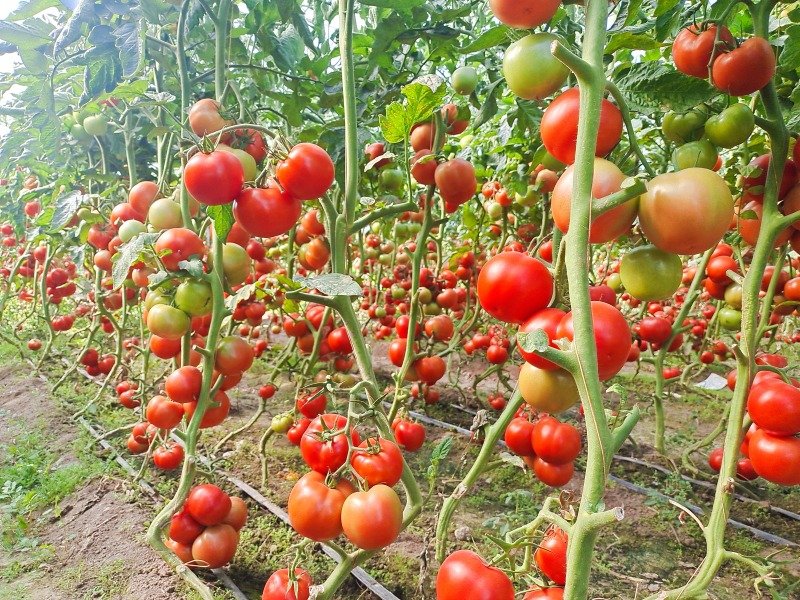
Drip Irrigation Tape for Tomatoes: Spacing, Flow Rate & Setup 2026
Choosing the right drip irrigation tape for tomatoes determines fruit sizing consistency, export-grade yield, and system lifespan across your growing seasons. This guide covers the complete specification — emitter spacing, wall thickness, flow rate, and installation sequence — for commercial tomato production in Latin America, the Middle East, and Southeast Asia.
Focus keyword: drip irrigation tape tomatoes · Updated: June 2026 · Reading time: ~8 min
▶ Quick Answer: Recommended Specification
Standard specification for drip irrigation tape for tomatoes in commercial export production: 16mm tube · 0.18mm wall · 20–30cm emitter spacing · 1.38 L/h · 100% virgin LLDPE. Upgrade to 0.20mm in high-UV regions (northern Mexico, Jordan Valley, Saudi Arabia). Flat emitter tape only — labyrinth tape output variance causes inconsistent fruit sizing that directly reduces export-grade yield percentage.
Why Specification Matters for Tomato Yield
Selecting the correct drip irrigation tape for tomatoes is the starting point for export-grade commercial tomato production. Tight grading tolerances on fruit diameter, colour uniformity, and brix consistency are all directly influenced by irrigation uniformity. Fruit diameter, colour uniformity, and brix consistency are all graded at the packhouse — and all three are directly influenced by irrigation uniformity across the growing season. Inconsistent drip irrigation tape for tomatoes — whether from incorrect emitter spacing, inadequate wall thickness, or substandard raw material — shows up in the grading results before it shows up on the tape itself.
The three specification decisions that have the most impact on tomato grading outcomes:
- Emitter spacing: Too wide on light soils creates dry zones between emitters. Moisture stress during fruit set — even brief — causes blossom drop and reduces the number of fruit per truss. During fruit fill, moisture stress reduces final fruit size and increases the proportion of fruit that fails the minimum diameter grade.
- Emitter type: Labyrinth tape output variance creates systematically uneven zones across a run. At 10% output variance, every 10th meter of your tomato row is receiving measurably different moisture than the rest. The grading impact of this compounds across a full season.
- Raw material: Blended material tape degrades mid-season in high-UV open-field conditions. Pressure loss from wall degradation reduces delivery uniformity before visual failure is apparent. The yield impact of a deteriorating system occurs weeks before the tape visibly fails.
The specification logic: The correct drip irrigation tape for tomatoes specification is not a premium — it is the baseline that protects the export revenue the crop is planted to generate.
What Different Buyers Actually Care About
🍅 Export Tomato Farm Operators
Large-scale tomato operations in Mexico’s Sonora and Sinaloa, Jordan Valley, and Vietnam’s Lam Dong province operate under supermarket chain specifications that set minimum fruit diameter and brix requirements. Irrigation uniformity is not a secondary concern — it is a direct input into whether the season’s harvest meets contract grade. These farms need a verified specification they can rely on season after season.
They need: Batch-consistent 0.18mm or 0.20mm flat emitter tape with SGS certificate and measurement data per production lot.
🌍 Regional Distributors
Distributors supplying tomato farms across Latin America or Southeast Asia carry quality risk for every product recommendation they make. A tape failure in a customer’s 30ha tomato installation during peak season creates claims that exceed the margin on the entire product line. The distributor’s interest is consistent, verifiable product — not the lowest price per meter.
They need: A drip irrigation tape supplier who maintains specification across batches and provides documentation proactively.
🏗️ Greenhouse & Tunnel Operators
Greenhouse tomato production in the Middle East and Southeast Asia uses substrate systems (rockwool, coco coir) with very specific flow requirements. The drip irrigation tape specification for greenhouse tomatoes differs from open-field: lower UV exposure reduces wall thickness requirements, but precise low-volume delivery per plant is critical. These operations typically require shorter run lengths and more frequent lateral connections.
They need: 0.15–0.18mm tape at 20cm spacing with 1.0–1.38 L/h, optimized for per-plant precision delivery.
📋 Agronomy Consultants
Irrigation consultants specifying systems for tomato producers need technical data they can present to farm owners and auditors. A specification recommendation for drip irrigation tape for tomatoes must be defensible on agronomic grounds — soil type, climate zone, crop architecture — not just supplier preference. Reliable technical data from a verifiable supplier protects the consultant’s recommendation.
They need: Emitter output data at operating pressure, Cv values, and system design support documentation.
Drip Irrigation Tape for Tomatoes: Emitter Spacing, Flow Rate & Wall Thickness
Emitter Spacing: 20–30cm
The standard emitter spacing for drip irrigation tape for tomatoes is 20–30cm, selected based on soil texture:
- 20cm on sandy / light soils: Limited lateral water movement means emitter wetting fronts must be closer together to maintain continuous moisture coverage at the root zone. On coarse soils, 30cm spacing creates dry zones that stress the plant during critical growth stages.
- 30cm on loamy / clay soils: Good lateral water movement means overlapping wetting fronts from 30cm-spaced emitters cover the root zone effectively. Using 20cm on these soils wastes water without agronomic benefit.
- Avoid spacing above 30cm: Tomatoes are deep-rooted compared to strawberries, but blossom drop under moisture stress during fruit set is well-documented. Spacing above 30cm on any soil type is a risk for export-grade production.
Flow Rate: 1.38 L/h
1.38 L/h is the standard flow rate for open-field tomato production. Unlike strawberries — where 1.0 L/h is specified to reduce crown moisture and disease risk — tomatoes benefit from slightly higher flow rates that deliver water deeper into the root zone. For greenhouse substrate systems, 1.0 L/h gives more precise per-plant volume control.
Wall Thickness: 0.18mm Standard, 0.20mm for High-UV
0.18mm is adequate for most open-field tomato production at 1–2 seasons service. In high-UV regions where the tape is exposed to intense sunlight throughout the season and between seasons:
- Northern Mexico (Sonora, Sinaloa): 0.20mm recommended — strong UV, long growing seasons
- Jordan Valley / Saudi Arabia: 0.20mm minimum — extreme UV, arid conditions
- Southeast Asia (Vietnam, Thailand): 0.18mm standard — humid, moderate UV
- Greenhouse systems (any region): 0.15–0.18mm acceptable — minimal UV exposure
For the complete wall thickness decision guide, see
drip tape wall thickness: 0.15mm vs 0.18mm vs 0.20mm.
Specification Table: Drip Irrigation Tape for Tomatoes by Growing System
| Parameter | Open Field (Standard) | Open Field (High-UV) | Greenhouse / Tunnel |
|---|---|---|---|
| Tape type | Flat emitter | Flat emitter | Flat emitter |
| Wall thickness | 0.18mm | 0.20mm | 0.15–0.18mm |
| Emitter spacing | 20–30cm | 20–30cm | 20cm |
| Flow rate | 1.38 L/h | 1.38 L/h | 1.0–1.38 L/h |
| Raw material | 100% virgin LLDPE | 100% virgin LLDPE | 100% virgin LLDPE |
| Expected life | 1–2 seasons | 1–2 seasons | 2–3 seasons |
| Filtration | 120-mesh minimum | 120-mesh minimum | 120-mesh minimum |
| High-UV regions | Vietnam, Thailand, Morocco | N. Mexico, Jordan Valley, Saudi | Any region |
Reference: FAO Irrigation and Drainage. Specifications on our drip irrigation tape product page.
Installation Sequence for Commercial Tomato Production
1
Prepare beds and lay sub-lateral pipes
Form raised beds or prepare flat rows according to your planting plan. Lay sub-lateral supply pipes along the field first and flush clear. For double-row tomato systems, position the sub-lateral at the row centre to supply both rows from one lateral connection.
2
Connect and position tape with emitters facing up
Connect the drip irrigation tape to sub-laterals using 16mm barbed fittings. Run the tape along the row with emitters facing upward at the 12 o’clock position. For single-row beds, one tape run centred on the row. For beds with two tomato rows, one tape per row or one tape centred if row spacing is ≤40cm and soil is loamy.
3
Flush the system before mulching
Open end caps and run water for 3–5 minutes per run before laying mulch. This removes installation debris (soil particles, fitting shavings) that would block emitters under mulch. Flushing after mulching requires removing the mulch — a step that damages both the film and the soil structure underneath.
4
Apply plastic mulch film
Cover beds with black or silver-black mulch. Black film suppresses weeds and retains moisture. Silver-black film reflects light, reducing soil temperature — beneficial in high-temperature growing regions including Southeast Asia and the Middle East. Anchor edges securely.
5
Verify output and transplant
Run the system at operating pressure and check for uniform output along the full run length before transplanting. Any non-dripping emitters should be located and addressed before the crop goes in — finding a blocked emitter in a 100m run under established tomato plants is significantly more difficult than at this stage.
Tomatoes vs Peppers vs Strawberries: Specification Comparison
Understanding where tomato specifications align with or differ from other major crops simplifies multi-crop farm procurement decisions.
| Parameter | 🍅 Tomatoes | 🌶️ Peppers | 🍓 Strawberries |
|---|---|---|---|
| Wall thickness (standard) | 0.18mm | 0.18mm | 0.20mm |
| Emitter spacing | 20–30cm | 20–30cm | 10–15cm |
| Flow rate | 1.38 L/h | 1.0–1.38 L/h | 1.0 L/h |
| Tape per hectare (0.60m rows) | ≈ 18,300 m | ≈ 22,000 m | ≈ 36,700 m |
| System life | 1–2 seasons | 1–2 seasons | 2–3 seasons |
| Key disease risk from wrong spec | Blossom drop, uneven sizing | Uneven sizing, stem disease | Crown rot, size variation |
Detailed guides: drip tape for peppers ·
drip tape for strawberries.
For tape type selection: flat emitter vs labyrinth guide.
How Many Meters of Drip Irrigation Tape Per Hectare of Tomatoes?
To calculate meters of drip irrigation tape for tomatoes, use the formula: (Field width ÷ Row spacing) × Field length × 1.10
Reference figures for tomatoes (100m × 100m field):
- 0.50m row spacing → ≈ 22,000 m/ha (11 rolls of 2,000m)
- 0.60m row spacing → ≈ 18,300 m/ha (10 rolls of 2,000m)
- 0.75m row spacing → ≈ 14,700 m/ha (8 rolls of 2,000m)
Use the interactive calculator with your exact field dimensions:
Drip Tape Per Hectare Calculator →
Sourcing drip irrigation tape for tomatoes?
Tell us your growing system, region, and quantity for drip irrigation tape for tomatoes — we will confirm the correct specification, provide SGS raw material certificate, and prepare a quotation within one business day.
Frequently Asked Questions
Tomato Irrigation
Drip Tape
Drip Irrigation
Precision Irrigation
Horticulture
Smart Farming